Introduction:
You checked the fridge, found the bag, and now you’re staring at a lot code trying to decide if you’re a hypochondriac or a headline. That’s the exact moment a food recall stops being a news story and becomes a personal decision. And if you’ve eaten a Taylor Farms product in the last few years, there’s a decent chance you’ve had that moment the company’s name has been attached to more than one recall, across more than one country, for more than one reason.
Here’s the thing nobody tells you in the recall notice: the notice is the easy part. The hard part is figuring out, at 11pm, whether that stomach cramp is dinner disagreeing with you or something that needs a doctor’s attention tonight. That’s where telehealth earns its keep. Not as a replacement for the emergency room when things go sideways, but as the fast, low-friction first call that tells you which way to go.
This isn’t a scare piece. It’s a field guide what’s actually been recalled, what the different pathogens do to your body, and the specific moments when opening a telehealth app is the smartest move you can make.
A Quick Reality Check on Taylor Farms
Taylor Farms is one of the largest fresh-cut produce suppliers in North America, which is precisely why its name keeps surfacing. When a company packages salad kits, chopped vegetables, and stir-fry blends for grocery chains and fast-food giants across three countries, its footprint is enormous and so is its exposure every time something upstream goes wrong. A recall from a company this size doesn’t necessarily mean the operation is reckless; it often means the surveillance system built around fresh produce is doing exactly what it’s supposed to do.
That distinction matters, because “is Taylor Farms safe to eat now?” is one of the most common questions people search the moment a recall hits the news. The honest answer is: it depends entirely on which product, which lot number, and which recall you’re asking about because there have been several, and they are not all the same.
The Recall Timeline: What Actually Happened
Below is a plain-English rundown of Taylor Farms’ most notable recalls, verified against official government sources rather than secondhand chatter.
| Year | Product | Pathogen / Issue | Region | Source |
|---|---|---|---|---|
| 2017 | Signature Café Southwest Style Salad with Chicken, H-E-B pork ranch salad | Listeria monocytogenes (from a supplier’s cheese ingredient) | United States | FSIS recall notice |
| 2021 | Mushroom Stir Fry Kit, 9 oz (Kroger stores) | Listeria monocytogenes | United States (South/Southeast) | FDA recall notice |
| 2024 | Yellow onions supplied to McDonald’s and other food-service customers | E. coli O157:H7 | United States | FDA outbreak investigation |
| 2024 | Sweet Kale Chopped Kit, 340g | Salmonella | Canada (Ontario, Quebec, Atlantic provinces) | CBC News / CFIA |
| 2025 | Honey Balsamic Salad Kit, 6/8.3 oz | Undeclared sesame and soy allergens | United States (25 states) | FDA recall notice |
| 2026 (open investigation, no recall issued) | Shredded iceberg lettuce served at Taco Bell locations; supplier not officially named by CDC/FDA | Cyclospora | United States (Indiana, Kentucky, Michigan, Ohio, West Virginia) | CDC outbreak notice |
A few things stand out once you lay it out like this. First, the 2024 onion recall the one tied to McDonald’s Quarter Pounders was the most serious by consequence: the CDC linked it to more than 100 illnesses across 14 states, dozens of hospitalizations, and one death, though investigators were never able to confirm the exact outbreak strain in the onions themselves. Second, the most recent recall, the 2025 Honey Balsamic Salad Kit, wasn’t a contamination issue at all it was a packaging mix-up where the wrong dressing packet, containing sesame and soy, ended up in the wrong box. No illnesses were reported. Third, if you’re in Canada asking whether Taylor Farms is “a Canadian company,” the answer is more nuanced than a yes or no: Taylor Farms operates a Canadian entity, Taylor Fresh Foods Canada, that sources and packages product for the Canadian market, which is why some recalls (like the Sweet Kale Salmonella issue) affected only Canadian provinces and never touched U.S. shelves. Fourth, and most current: the 2026 row is not a completed recall at all it’s an open federal investigation, and Taylor Farms’ name is attached through news reporting, not an official CDC or FDA statement. Treat it accordingly until that changes.
Is Taylor Farms Linked to Cyclospora?
This question comes up often enough that it deserves a careful, current answer, because it’s actively in motion as of this writing.
The history: yes, there’s real precedent. In 2013, the FDA traced a multistate cyclosporiasis outbreak that sickened hundreds of people in Iowa and Nebraska back to prepackaged salad mix from Taylor Farms de Mexico, a Mexico-based supplier connected to the company.
The present: the CDC and FDA are currently investigating an active, ongoing multistate Cyclospora outbreak, first flagged in mid-July 2026, tied to shredded iceberg lettuce served at Taco Bell locations across Indiana, Kentucky, Michigan, Ohio, and West Virginia. As of the CDC’s most recent update, more than 1,600 people have been reported sick and roughly 1 in 10 have been hospitalized, with no deaths reported. The FDA’s traceback work has identified a single lettuce supplier from Mexico tied to the affected restaurants but CDC and FDA have not officially named that supplier in any public notice. Several major news outlets, including the Washington Post, CNN, and NBC, have reported citing sources familiar with the investigation, not an official agency statement that the supplier is Taylor Farms. No recall has been issued in connection with this outbreak as of this writing, and the investigation remains open.
If you’ve eaten shredded lettuce at Taco Bell in the affected states recently and are experiencing watery diarrhea that won’t quit, cramping, or bloating that’s lasted more than a few days, that’s worth a same-day telehealth visit Cyclospora needs a specific stool test to confirm, and it doesn’t respond to the antibiotics used for more common bacterial food poisoning. Because this story is still developing, check the CDC’s outbreak page directly for the latest status rather than relying on any single article, including this one.
Know Your Enemy: What Each Pathogen Actually Does
Not all foodborne illness looks the same, and knowing which bug you might be dealing with changes how urgently you should act.
| Pathogen | Typical Onset | Common Symptoms | Who’s Most at Risk | Red-Flag Symptoms |
|---|---|---|---|---|
| Listeria monocytogenes | Up to 70 days later | Fever, muscle aches, sometimes nausea or diarrhea | Pregnant people, adults 65+, immunocompromised individuals | Stiff neck, confusion, loss of balance, fever during pregnancy |
| Salmonella | 6 hours–6 days | Diarrhea, fever, abdominal cramps | Young children, older adults, immunocompromised individuals | High fever, bloody stool, signs of dehydration |
| E. coli O157:H7 | 3–4 days (range 1–10) | Severe stomach cramps, diarrhea (often bloody), vomiting | Children under 5, older adults | Bloody diarrhea, decreased urination, unusual bruising or paleness (possible HUS) |
| Undeclared allergen (sesame/soy) | Minutes to 2 hours | Hives, swelling, itching, in severe cases trouble breathing | Anyone with a diagnosed allergy | Throat tightness, swelling of face/lips, difficulty breathing |
Notice how wide that onset window is, especially for Listeria. That delay is exactly why so many people don’t connect a fever three weeks from now with a salad they ate and forgot about. If you’re pregnant, over 65, or managing a condition that affects your immune system, it’s worth mentally filing away what you ate for the next couple of months after any produce recall involving your household.
So When Should You Actually Use Telehealth?
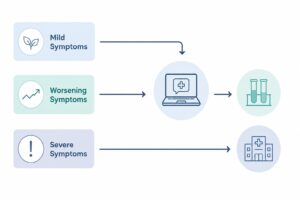
This is the part that matters most, and it comes down to matching your symptoms to the right tier of care. Think of it as a three-lane system.
Lane one: telehealth is exactly right. You’ve eaten a recalled product, you’re mildly symptomatic cramping, low-grade fever, a few episodes of diarrhea and you’re otherwise healthy and hydrating fine. A telehealth visit lets a clinician assess your symptoms, ask about the specific recall and timeline, and decide whether you need in-person testing, a stool culture, or simply supportive care at home. It’s also the right lane if you’re not sick yet but want documented guidance for what to watch for, especially if you’re pregnant or caring for a young child.
Lane two: telehealth first, in-person likely next. You have a fever that won’t break, diarrhea lasting more than three days, or you’re pregnant and had any exposure to a product under Listeria recall. A telehealth provider can triage quickly and often gets you into a lab for stool or blood testing same-day, which is faster than waiting for a same-week primary care appointment.
Lane three: skip telehealth, go straight to urgent or emergency care. Bloody diarrhea, signs of dehydration (dizziness, dry mouth, minimal urination), a fever above 102°F (39°C), confusion, a stiff neck, or any sign of an allergic reaction affecting breathing or swelling of the face and throat. These are situations where minutes matter and a screen-based visit will only slow you down.
What Actually Happens on a Telehealth Visit for Food Poisoning
If you’ve never used telehealth for something like this, the process is more straightforward than people expect. A typical visit runs through:
- A symptom timeline when you ate the product, when symptoms started, and what they’ve looked like since
- A review of the specific recall, since the same visit for a Listeria concern looks very different from one for a soy allergy reaction
- A risk assessment based on your age, pregnancy status, and any underlying conditions
- A decision on next steps: home monitoring, an e-prescription (for example, anti-nausea medication), an order for in-person stool or blood testing, or a direct referral to urgent care
Most platforms can also route you to a local lab same-day if a stool culture is warranted, which matters because pinpointing the exact pathogen changes both your treatment and how the case gets reported to public health authorities tracking the outbreak.
Is It Safe to Eat Taylor Farms Salad Kits Right Now?
As of this writing, none of Taylor Farms’ currently sold salad kits are under an active U.S. or Canadian recall the incidents above have each been resolved, with affected lots pulled from shelves and, in the FDA and CFIA’s language, the recalls “completed” or “terminated.” The one exception worth naming plainly: there is an open, unresolved federal investigation into a Cyclospora outbreak tied to lettuce, and while no recall has been issued and Taylor Farms hasn’t been officially confirmed as the supplier, it’s the subject of active reporting on that front. That said, the practical habit worth keeping regardless of any specific recall or investigation:
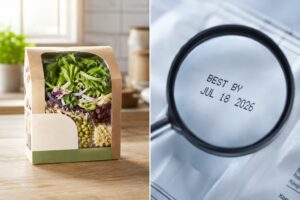
- Check lot codes and “Best By” or “Use By” dates against your country’s food safety agency recall page before eating a bagged salad or kit, especially in the days after any recall headline
- Store bagged salads at or below 40°F (4°C) Listeria, unlike most foodborne bacteria, can slowly multiply even under refrigeration
- Don’t assume “prepackaged” means “pre-washed” always give bagged produce a rinse unless the label explicitly states it’s ready-to-eat and pre-washed
- If you or someone in your household has a soy or sesame allergy, check dressing packets against the manufacturer’s current allergen list rather than assuming the outer box label is accurate, given the 2025 mix-up
Frequently Asked Questions
Is Taylor Farms safe to eat now? As of this writing, Taylor Farms’ official recall page (last updated July 14, 2026) shows no active product recall, and this holds up against current FDA and USDA-FSIS records. That said, there is an open, unresolved CDC/FDA investigation into a Cyclospora outbreak tied to shredded lettuce served at Taco Bell in five states, and several news outlets have reported via sources, not official confirmation that Taylor Farms is the supplier under scrutiny. No recall has been issued as part of that investigation yet. Given how fast this is moving, check the official Taylor Farms recall page and the CDC’s outbreak notice directly before assuming the situation hasn’t changed.
Is it safe to eat Taylor Farms salad kits? Generally, yes, provided the specific product and lot code aren’t listed on an active recall. The company’s salad kits have been affected by isolated recalls (an allergen mix-up in 2025, a Salmonella concern in Canada in 2024), but these were resolved and don’t apply to current production. Separately, an open 2026 federal investigation into a Cyclospora outbreak is focused specifically on shredded lettuce served at Taco Bell restaurants, not on Taylor Farms’ packaged salad kit line worth knowing the difference before assuming either product is or isn’t affected.
Is Taylor Farms linked to Cyclospora? Historically, yes a 2013 outbreak in Iowa and Nebraska was traced to Taylor Farms de Mexico. As of this writing, there’s also an open CDC/FDA investigation into a 2026 Cyclospora outbreak tied to lettuce served at Taco Bell in five states; multiple news outlets have reported, based on sources, that Taylor Farms is the supplier involved, though CDC and FDA have not officially confirmed the supplier’s identity and no recall has been issued. This is a developing situation see the CDC’s outbreak page for the latest.
Is Taylor Farms a Canadian company? Taylor Farms is headquartered in Salinas, California, but operates a Canadian subsidiary, Taylor Fresh Foods Canada, which supplies and packages products specifically for the Canadian market which is why some recalls have applied only to Canadian provinces.
Has Taylor Farms had any recalls? Yes, several, spanning 2016 through 2025 and involving Listeria, Salmonella, E. coli, and undeclared allergens. The most consequential was the 2024 E. coli outbreak tied to onions supplied to McDonald’s, which the CDC linked to more than 100 illnesses and one death. As of this writing, there’s also an open (not-yet-resolved) federal investigation into a 2026 Cyclospora outbreak that news reporting has connected to Taylor Farms, though no recall has been issued in relation to it.
Where is Taylor Farms lettuce grown? Taylor Farms sources produce from growing regions across California (notably Salinas Valley), Arizona, and contracted farms depending on the season, alongside Canadian-grown produce for its Canadian operations. Specific grower information for any given recall is typically listed in the FDA or CFIA traceback notice.
What should I do if I’m still experiencing symptoms days after eating a recalled product? If diarrhea persists beyond three days, you develop a high fever, or you notice blood in your stool, don’t wait it out start with a telehealth visit to get triaged quickly, and be ready to escalate to in-person or emergency care if symptoms are severe.
The Bottom Line
Recalls will keep happening that’s not a Taylor Farms problem, it’s a produce-industry-wide reality of a food system built for speed and scale. What you control is how fast you act once one lands in your kitchen: checking your lot codes, tracking your symptoms honestly, and knowing which lane of care actually fits what you’re feeling. A telehealth visit costs you fifteen minutes and gets you a professional opinion before you’ve even found parking at urgent care. Use it as your first move, not your last resort and if your body is telling you something more serious is happening, don’t let convenience talk you out of the ER.
If you’ve recently checked a bag against a recall list and you’re not sure what to do next, that uncertainty is reason enough to talk to someone. A telehealth visit is often the fastest way to get a clear answer.
Sources & References
- USDA FSIS — Taylor Farms Recalls Chicken and Pork Salad Products Due to Possible Listeria
- FDA — Taylor Farms Mushroom Stir Fry, 9 oz
- FDA — Outbreak Investigation of E. coli O157:H7: Onions (October 2024)
- CBC News — Taylor Farms Sweet Kale Salad Recall
- FDA — Company Voluntarily Recalls Honey Balsamic Salad Kit Due to Potential Undeclared Sesame and Soy
- Taylor Farms — Official Recall Page
- CDC — Cyclospora Outbreak Linked to Shredded Iceberg Lettuce Served at Taco Bell (July 2026)