Introduction:
If you’ve noticed headlines about a Cyclospora outbreak this summer, you’re not imagining things. The United States is in the middle of one of its largest cyclosporiasis seasons on record, driven in part by a multistate outbreak linked to iceberg lettuce. Thousands of people have gotten sick, and public health officials are still investigating several unrelated clusters at the same time.
If you’ve had unexplained, watery diarrhea that won’t quit or you’re just trying to understand what’s going on before your next grocery run or trip this guide walks through what Cyclospora is, how people get infected, what the symptoms look like, how it’s treated, and what you can actually do to lower your risk.

What Is Cyclospora?
Cyclospora cayetanensis usually just called Cyclospora is a microscopic, single-celled parasite that causes an intestinal illness known as cyclosporiasis. It’s not a virus or bacterium; it’s a protozoan parasite that lives in the human gut and is shed in stool.
People become infected by eating food or drinking water contaminated with feces that contain the parasite. This is almost always a foodborne (or occasionally waterborne) illness, not something you catch from being near a sick person. That’s an important distinction, and one we’ll come back to.
In the United States, cyclosporiasis has a defined “season.” Cases typically rise in spring and summer, and the CDC formally tracks the cyclosporiasis season as May 1 through August 31 each year.
The 2026 Cyclospora Outbreak: What’s Happening
This year’s numbers stand out. As of August 24, 2026, the CDC had received reports of 17,180 laboratory-confirmed cyclosporiasis cases acquired within the United States since the season began on May 1. For comparison, only 1,180 cases were reported over the same stretch in 2025 meaning this season’s confirmed case count is more than 14 times higher than last year’s.
Of those U.S.-acquired cases, the CDC reports 922 hospitalizations and 2 deaths. Cases have been reported in 48 states plus the District of Columbia, with a median patient age of 46 and a slight majority (56%) of cases occurring in women. The agency also notes it’s aware of nearly 12,000 additional suspected cases still being confirmed or investigated, so the final tally for the season will likely climb further.
A large outbreak tied to iceberg lettuce
Much of the surge is linked to a specific, ongoing multistate outbreak. According to the CDC, this outbreak now under investigation together with the FDA has been traced to processed iceberg lettuce sourced from central Mexico. On July 17, 2026, the supplier, Taylor Farms de Mexico, recalled all iceberg lettuce sourced from that region. The best-by dates on the recalled product have since passed, and the CDC says it should no longer be available in stores or restaurants.
As of the latest update, this single outbreak accounts for roughly 10,930 of the season’s cases, with 454 hospitalizations and 2 deaths, spread across 17 states.
Importantly, this is not the only thing going on. The CDC has said it’s investigating at least six other clusters of cyclosporiasis for which a source hasn’t yet been confirmed, meaning some of this year’s cases have nothing to do with the lettuce recall at all.
Season snapshot: 2026 vs. 2025
| Measure | 2026 (May 1 – Aug. 24) | 2025 (full May 1 – Aug. 31 season) |
|---|---|---|
| U.S.-acquired confirmed cases | 17,180 | 1,180 |
| Hospitalizations | 922 | 105 |
| Deaths | 2 | 0 |
| States reporting cases | 48 + D.C. | Fewer (full state count not broken out by CDC for direct comparison) |
Sources: CDC Cyclospora Case Data, updated August 25, 2026, and CDC’s cyclosporiasis surveillance data for the 2025 season. Figures are preliminary and subject to change as more cases are confirmed. Note the 2025 column reflects the full season through August 31, while the 2026 column reflects data through August 24, so the comparison slightly understates how much larger 2026 is likely to end up.
It’s worth being precise about what these numbers mean. The CDC is clear that reported cases likely undercount the true number of infections, since many people recover on their own without ever being tested. There’s also a reporting lag it can take about six weeks from when someone gets sick to when their case shows up in national data so the most recent weeks in any chart will look artificially low and tend to rise as more reports come in.
How Do People Get Cyclospora?
Cyclospora spreads when someone eats food or drinks water contaminated with human feces containing the parasite. A few things make this parasite tricky from a food-safety standpoint:
- It has a required environmental “maturation” period. After the parasite passes in a bowel movement, it needs roughly one to two weeks outside the body before it becomes infectious. Because of this, the CDC notes that direct person-to-person spread is unlikely you generally can’t catch it from touching a sick person or being in the same room as them.
- Routine sanitizers may not work. Washing contaminated produce reduces risk but doesn’t guarantee removal of the parasite, and typical chemical disinfectants used on food or surfaces aren’t proven effective against it.
- Cooking is more reliable than washing alone. Heating food to at least 158°F (70°C) can kill the parasite, according to FDA guidance.
What food is Cyclospora found in?
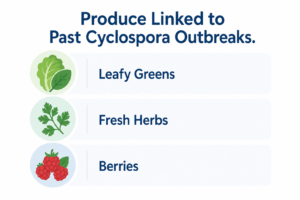
Historically, U.S. outbreaks have been linked to imported fresh produce items typically eaten raw, without cooking, which removes the one step (heat) known to reliably kill the parasite. Past outbreaks have implicated items such as fresh herbs, leafy greens, and certain berries and legumes, in addition to this year’s iceberg lettuce outbreak. The common thread is fresh, minimally processed produce that isn’t cooked before it’s eaten.
People can also be exposed while traveling to, or eating imported food originally grown in, tropical and subtropical regions where cyclosporiasis is more endemic. The CDC’s data this season also tracks cases acquired outside the U.S. separately: 1,805 such cases were reported between May 1 and August 24, 2026, tied to travel and consumption of food or water abroad.
Symptoms of Cyclospora Infection
Not everyone who’s infected develops symptoms, but when illness does occur, it can be prolonged and disruptive. Symptoms typically begin about one week after exposure, though the incubation period can range from 2 to 14 days.
Common symptoms:
- Watery diarrhea, which can be frequent
- Loss of appetite
- Weight loss
- Bloating and increased gas
- Cramping
- Nausea
- Fatigue
Less common symptoms:
- Low-grade fever
- Vomiting
How long does a Cyclospora infection last?
Without treatment, cyclosporiasis can follow what the CDC calls a “remitting-relapsing” course symptoms may ease up and then come back one or more times. Left untreated, illness can last anywhere from a few days to a month or longer. Most people with healthy immune systems eventually recover even without medication, but the illness can be unpleasant and prolonged in the meantime. Possible complications, though less common, include malabsorption, gallbladder inflammation (cholecystitis), and reactive arthritis.
Is Cyclospora contagious?
Not in the way most stomach bugs are. Because the parasite needs time in the environment to become infectious after being passed in stool, cyclosporiasis doesn’t spread easily from person to person, even in households or healthcare settings. The real transmission route is contaminated food or water which is why outbreaks tend to trace back to a specific product rather than spreading through close contact.
Who’s at Higher Risk?
Anyone can get cyclosporiasis, but a few groups face a higher chance of exposure or more severe illness:
- People traveling to or living in tropical or subtropical regions where the parasite is more common
- Anyone eating imported fresh produce, particularly raw items not intended to be cooked
- People with weakened immune systems or underlying poor health, who the CDC notes may be at higher risk for a more severe or prolonged illness
- It’s also possible to be infected with Cyclospora more than once, so a past infection doesn’t provide lasting protection
How Do I Know If I Have Cyclospora?
Because the symptoms overlap with many other causes of diarrhea, cyclosporiasis can’t be diagnosed by symptoms alone. Diagnosis requires a stool test but not just any stool test.
The CDC has specifically flagged that Cyclospora can be difficult to detect, and routine “ova and parasite” (O&P) stool exams don’t reliably catch it. If you have prolonged or relapsing watery diarrhea especially during the May-to-August season, and even without recent travel it’s worth asking your healthcare provider to specifically test for Cyclospora, using specialized staining techniques or PCR-based testing where available. You may need to submit stool samples on more than one day, since the parasite isn’t always detectable in a single sample.
How Is Cyclospora Infection Treated?
What antibiotic kills Cyclospora?
The standard treatment is a course of trimethoprim-sulfamethoxazole (TMP-SMX) sold under brand names such as Bactrim, Septra, or Cotrim typically for 7 to 10 days in immunocompetent adults and children over 2 months old. People with weakened immune systems may need a longer course, and dosing should always be determined by a healthcare provider based on individual health factors.
If you’re allergic to sulfa drugs, talk to your healthcare provider about alternative treatment options, since TMP-SMX contains a sulfonamide component.
Can you get rid of Cyclospora without antibiotics?
Many people with healthy immune systems do eventually clear the infection on their own, without medication. However, that can mean weeks of relapsing diarrhea, fatigue, and discomfort. Because untreated cyclosporiasis can drag on and cause complications in some people, seeing a healthcare provider for proper diagnosis and treatment is generally the better path rather than waiting it out particularly for anyone who is immunocompromised, pregnant, elderly, or a young child.
Alongside any prescribed treatment, staying well-hydrated is important, especially if diarrhea is frequent. Resting and replacing fluids and electrolytes support recovery while the infection clears.

How to Prevent Cyclospora Infection
There’s no vaccine for cyclosporiasis, so prevention comes down to food and water safety:
- Wash your hands and fresh produce thoroughly under clean running water before eating, cutting, or cooking even if produce is labeled pre-washed.
- Cook produce when possible. Heating food to at least 158°F (70°C) can kill the parasite; washing alone cannot guarantee removal.
- Stay aware of active recalls. Check for current food recalls and outbreak notices before assuming a product is safe, particularly for imported leafy greens, herbs, and berries.
- Follow safe water practices while traveling, particularly in regions where cyclosporiasis is more common.
- Report suspected foodborne illness. If you get sick and suspect a specific food, reporting it helps investigators identify sources faster.
How to avoid Cyclospora while traveling to Mexico
Because a portion of this year’s cases (and some past outbreaks) have been tied to produce grown in Mexico, and cyclosporiasis is more broadly endemic in tropical and subtropical regions, travelers to Mexico and similar destinations should take extra care: stick to thoroughly cooked food where possible, wash any raw produce carefully, be cautious with tap water, and avoid ice made from untreated water. These are general food and water safety precautions rather than a guarantee against infection, since the parasite can be difficult to fully remove through washing alone.
When Should You See a Doctor?
Contact a healthcare provider if you have:
- Watery diarrhea that lasts more than a few days
- Diarrhea that seems to improve and then returns
- Signs of dehydration, such as reduced urination, dizziness, or extreme thirst
- Diarrhea alongside a weakened immune system or other chronic health condition
Cyclosporiasis is not usually life-threatening, but it can make some people quite sick, and getting a specific test for Cyclospora rather than assuming it’s a routine stomach bug is often the fastest route to effective treatment.
A Note for Readers in Canada and the UK
The case data and outbreak details above reflect U.S. surveillance from the CDC, since this year’s large outbreak has been concentrated in the United States. Cyclosporiasis does occur elsewhere, generally at lower levels, and typically in connection with travel or imported produce. If you’re in Canada, the Public Health Agency of Canada and provincial health authorities are the right places to check for any Canada-specific advisories. In the UK, the UK Health Security Agency and NHS provide guidance on parasitic gastrointestinal illnesses and travel health precautions. If you develop persistent watery diarrhea after travel or eating imported produce, contact your own healthcare provider or national health service for testing and guidance specific to your country.
Frequently Asked Questions
Will Cyclospora go away on its own? For many people with healthy immune systems, yes the infection can eventually clear without treatment. But it may take anywhere from a few days to a month or longer, and symptoms can relapse in the meantime. Treatment with antibiotics typically resolves it faster and more reliably.
Has Cyclospora been found in Canada? Cyclosporiasis cases occur in Canada, generally at much lower levels than the current U.S. outbreak, and are often linked to travel or imported produce. Check the Public Health Agency of Canada for the most current Canadian surveillance data.
What kills the Cyclospora parasite? Cooking food to at least 158°F (70°C) can kill the parasite. Washing reduces contamination but doesn’t guarantee removal. For infections in the body, treatment is generally trimethoprim-sulfamethoxazole (TMP-SMX), prescribed by a healthcare provider.
How do I know if I have Cyclospora? The only reliable way to know is a specific stool test requested by your healthcare provider, since routine stool exams often miss this parasite. Watery diarrhea lasting more than a few days, especially with fatigue and appetite loss, is a reason to ask about testing.
What happens if Cyclospora goes untreated? Untreated infections can last from a few days to a month or longer, often with symptoms that ease and then return. Most healthy adults recover eventually, but people with weakened immune systems may experience more severe or prolonged illness.
How to treat a Cyclospora infection? The standard treatment is a 7–10 day course of trimethoprim-sulfamethoxazole, along with rest and staying well-hydrated. People allergic to sulfa drugs should discuss alternatives with their healthcare provider.
Where is Cyclospora most commonly found? It’s more common in tropical and subtropical regions and has been linked in the U.S. to imported fresh produce such as leafy greens, herbs, and berries including this year’s outbreak tied to iceberg lettuce from central Mexico.
How common is Cyclospora right now? As of late August 2026, the U.S. is experiencing a significantly larger season than usual, with over 17,000 confirmed domestic cases reported to the CDC since May 1 more than 14 times the case count reported over the same period in 2025.
How contagious is Cyclospora? It’s not very contagious person-to-person. The parasite needs one to two weeks in the environment after being passed in stool before it can infect someone else, so it spreads mainly through contaminated food and water rather than close contact.
Can you get rid of Cyclospora without antibiotics? Sometimes, particularly in people with healthy immune systems, though it can take weeks and involve relapsing symptoms. Antibiotic treatment is the more reliable and faster option, and it’s recommended for anyone with a confirmed infection.
The Bottom Line
This year’s Cyclospora season has been unusually large, driven substantially by an iceberg lettuce outbreak that’s already led to a recall, alongside several other clusters still under investigation. If you’ve had watery diarrhea lasting more than a few days particularly after eating raw produce or traveling it’s worth talking to a healthcare provider and specifically asking about Cyclospora testing, since standard stool tests often miss it. The good news is that effective antibiotic treatment exists, and simple steps like thoroughly washing or cooking produce and staying alert to food recalls can meaningfully lower your risk going forward.
Sources & Further Reading
This article draws on current data and guidance from the CDC. For the latest updates and more detailed information, visit:
- CDC — Cyclospora Case Data
- CDC — About Cyclosporiasis (Symptoms, Causes, Treatment)
- CDC — Cyclospora Outbreak Linked to Iceberg Lettuce
- CDC Health Alert Network — Domestically Acquired Cyclosporiasis Cases, 2026
- CDC — Clinical Care of Cyclosporiasis (for healthcare providers)
- CDC — Preventing Cyclosporiasis
- FDA — Foodborne Outbreaks & Illness Investigations
This article is for general informational purposes and is not a substitute for professional medical advice. If you’re experiencing symptoms, consult a licensed healthcare provider.