Introduction
There’s a particular kind of paralysis that hits the moment you decide, for real this time, to get in shape. You open the App Store looking for a nudge in the right direction and instead find eleven thousand apps, all promising to be “the one,” all wielding the same stock photo of someone flipping a tire at golden hour. You close the app. You order takeout. The cycle continues.
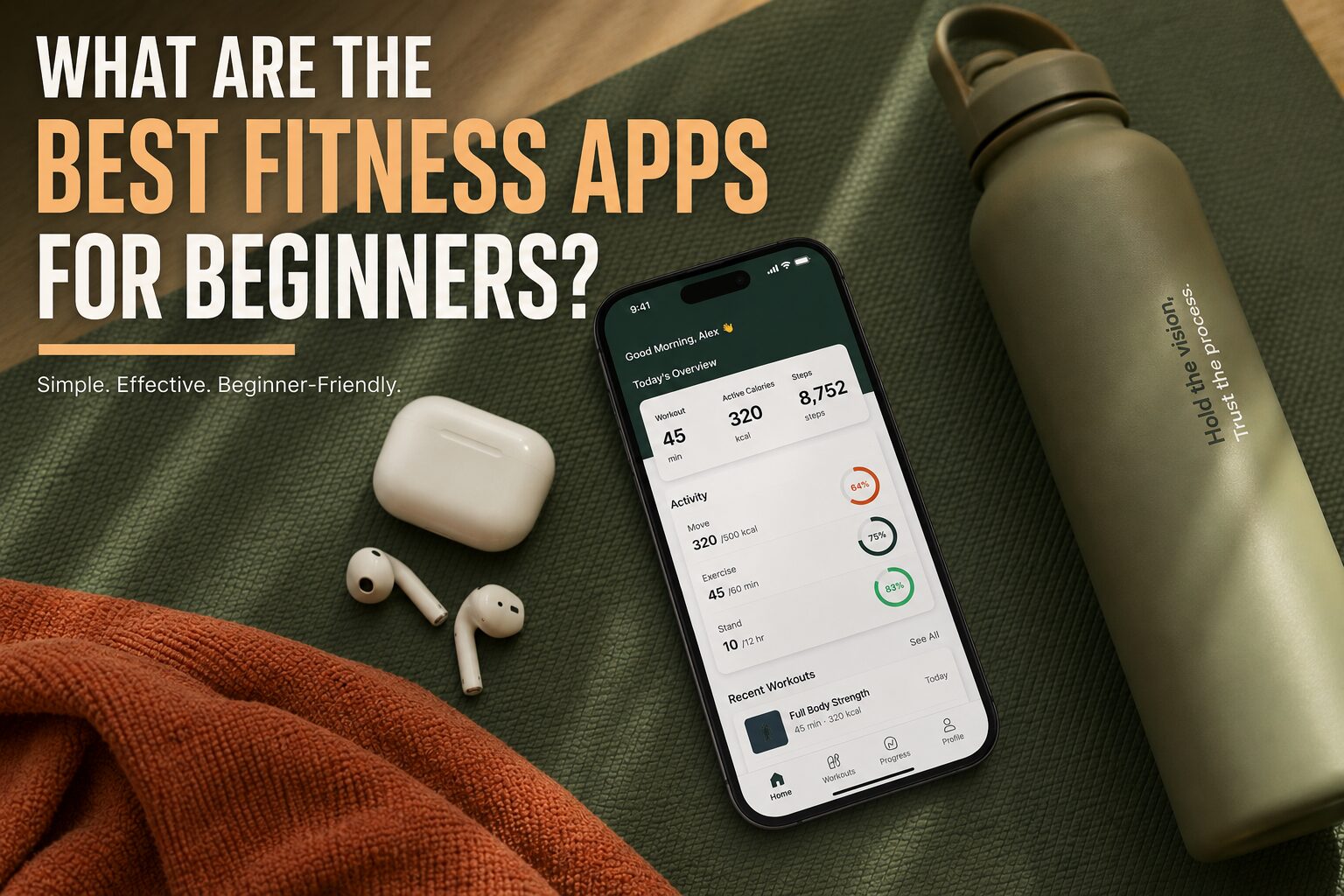
Here’s the truth nobody puts in the headline: the best fitness apps for beginners aren’t the one with the most features, the flashiest AI, or the celebrity trainer roster. It’s the one that tells you exactly what to do today, in a session short enough that you’ll actually finish it, without demanding you first earn a kinesiology degree to understand the instructions. That’s it. That’s the whole secret.
This guide breaks down what’s actually worth your storage space in 2026 across the US, Canada, and the UK whether you want something free, something guided, or something built specifically for the way your body is changing right now.

Which Fitness App Is Best for Beginners?
The honest answer is: it depends on what kind of beginner you are. Someone who’s never exercised in their life needs something categorically different from someone who used to run marathons and is easing back in after a two-year hiatus. But a few names come up again and again when trainers and reviewers actually test these things head to head rather than just reading the marketing copy.
Independent testing has repeatedly pointed to Daily Burn, Apple Fitness+, FitOn, Future, and Down Dog as standout picks for people who have genuinely never exercised before, largely because they lead with beginner-only programs, show modifications for every movement, and pair video instruction with a structured plan instead of dumping you into an overwhelming class library. That last part matters more than it sounds. A true beginner needs a clear, day-by-day plan; low-impact and seated modifications on screen; trainers who explain form instead of racing through reps; and sessions capped at 30 minutes or less, especially for the first month.
For a free, no-strings starting point, Nike Training Club remains one of the most accessible options, offering more than 200 free workouts spanning strength, endurance, yoga, and mobility, in sessions from 5 to 50 minutes, using either bodyweight or basic equipment. FitOn is the pick if variety matters more to you than structure unlimited free classes across cardio, strength, HIIT, Pilates, yoga, dance, and barre, with no equipment required and a dedicated beginner section under its “For You” tab.
If your goal leans more toward learning actual strength training rather than following along with classes, Fitbod uses AI to build personalized plans around your goals, available equipment, and training history, and while it leans toward serious lifters, its simplicity and guided structure make it workable for beginners who want to build consistent gym habits. JEFIT, meanwhile, is built for people whose beginner goal is specifically strength training and gym confidence, pairing a free Basic tier with over 1,400 exercises, logging, and community support.
And if you’d rather have every decision made for you, nutrition, mindfulness, and workouts bundled into one system Centr offers a dedicated “Beginner” fitness level for people new to exercise or returning after a break, plus a 3-week no-equipment program called Centr Begin, built specifically for absolute beginners.
Quick Comparison: Beginner-Friendly Fitness Apps
| App | Best For | Cost Model | Equipment Needed | Standout Feature |
|---|---|---|---|---|
| Nike Training Club | Free structured start | Free | None to minimal | 200+ free guided workouts |
| FitOn | Variety without equipment | Free | None | Unlimited classes, celebrity trainers |
| Daily Burn | True first-timers | Paid, free trial | None to minimal | “True Beginner” day-by-day program |
| JEFIT | Learning strength training | Free tier + premium | Gym or dumbbells | 1,400+ exercise library |
| Fitbod | AI-guided lifting | Paid, free trial | Whatever you have | Adapts to your equipment automatically |
| Centr | All-in-one wellness | Paid, free trial | Minimal | 3-week Centr Begin beginner program |
| Down Dog | Yoga and low-impact | Paid, free trial | None | Generates a new class every session |
Is There a 100% Free Fitness App?
Yes, and this is genuinely good news, because the idea that you need a premium subscription to get real results is mostly a marketing story. A free workout app can absolutely be enough, especially when you’re just getting started, because results come from consistency and progressive overload, not from paying for a premium tier.
For structured strength training with zero cost, StrongLifts 5×5 is completely free for its basic barbell program, and if you’re a beginner who just wants to squat, bench, and deadlift with automatic progression built in, that’s genuinely all you need. For general fitness with a class-style feel, Nike Training Club and FitOn (both detailed above) remain the two most consistently recommended free options for beginners across the review landscape.
If you’re specifically looking for a tracking app rather than a workout program, Hevy is regularly cited as the best free option, offering solid tracking and social accountability features without requiring payment.
One honest caveat: “free” often means “free with limits.” JEFIT’s free tier includes ads and caps some tracking features. FitOn’s free library is enormous, but its home screen pushes upgrade prompts. Read the fine print before you commit your Monday mornings to any single app.
What Is the Best Workout App for Beginners in the UK?
If you’re based in the UK, there’s a free resource that doesn’t get nearly enough credit: the NHS’s own suite of fitness apps. The free NHS Couch to 5K app is a running program designed specifically for beginners and has helped millions of people start and maintain a running habit, typically completed in as little as 9 weeks. Alongside it, the free NHS Active 10 app anonymously tracks every minute of brisk walking you do, you simply put your phone in your pocket.
Couch to 5K is built for absolute beginners: it has you running three times a week with rest days in between, gradually increasing intensity, with a trainer guiding you through headphones the entire way. It’s not glamorous, and there’s no AI or celebrity trainer attached just a genuinely well-tested, medically-endorsed program that costs nothing.
For UK users managing a health condition or looking for tailored, low-cost options beyond running, the NHS’s “We Are Undefeatable” app offers free, tailored exercise programs suitable for a range of health conditions, wherever you are in your fitness journey.
What Is the 3/2/1 Rule in the Gym? (And Should You Actually Follow It?)
Before getting into the details: the 3/2/1, 3-3-3, and 5-5-5-30 “rules” covered in this section are social-media fitness trends, not clinical exercise guidelines. There is no governing body, sports-medicine organization, or peer-reviewed research behind any of these labels they’re shorthand that gained traction online because they’re catchy and easy to remember. That doesn’t make them useless (the underlying structure is often sound), but it does mean you should treat them as simple organizing templates, not prescriptions from an authority.
With that in mind: the 3/2/1 rule shows up constantly in search results, and here’s the honest answer: it depends who you ask, because two very different definitions are both in circulation.
The version most beginners encounter describes a weekly structure three days of strength training, two days of cardio, and one day of rest or mobility work, giving your body a balance of power-building, heart-healthy activity, and recovery. This is the friendlier, more approachable interpretation, and it’s the one most relevant if you’re just starting out and want a simple weekly template.
A second, more technical version used by some strength coaches describes intensity distribution within specific lifts training a movement pattern at three different intensity tiers across the week (light, moderate, and heavy loads). That version is aimed at intermediate and advanced lifters managing their own programming, not beginners picking their first routine.
For a true beginner, the simpler weekly-split interpretation is the more useful one to build around. Pick three strength days, two cardio days, and treat the seventh day as genuinely optional rest — not a day to feel guilty about.
What Is the 3-3-3 Rule for Working Out?
Same caveat as above: this is a popular social-media framework, not a clinical guideline. It has more than one meaning floating around fitness content right now, and it’s worth understanding both so you’re not confused when you see it used differently in different places.
The most common version, and the one most useful for beginners, describes a weekly schedule: three days of weight training, three days of cardio, and three days of rest or active recovery. The appeal is obvious it’s particularly effective for beginners, busy people, or anyone returning to training after time off, because it removes the friction of not knowing how to organize a week of exercise.
The other common version applies to a single session: three exercises per workout, three sets of each, done three times a week a structure that works because it limits your focus rather than overwhelming you with an exhaustive list of movements. This variation cuts through the noise with one clear promise: three workouts weekly, three key movements per session, three sets each no confusion, no overwhelm.
Whichever version you pick, the underlying principle is the same: it strips fitness back to what actually matters consistency, effort, and enough repetition for progress to happen rather than promising an instant transformation.
Which “Rule” Should a Beginner Actually Follow?
| Rule | Most Common Meaning | Best Suited For |
|---|---|---|
| 3/2/1 Rule | 3 days strength, 2 days cardio, 1 day rest/mobility (weekly) | Beginners wanting a simple weekly template |
| 3-3-3 Rule | 3 days lifting, 3 days cardio, 3 days rest or 3 exercises x 3 sets x 3x/week | Beginners and people returning after a break |
| 5-5-5-30 Rule | 5 push-ups, 5 squats, 5 lunges (per side), 30-second plank | A quick morning activation routine, not a full workout |
What Is the 5-5-5-30 Rule?
This is the clearest example of a social-media fitness trend on this list, it originated from a single creator’s post rather than any coaching or medical source, and it’s worth clarifying because it’s often mistaken for a complete workout program. It isn’t. The 5-5-5-30 method is a short morning routine consisting of 5 push-ups, 5 squats, 5 lunges per side, and a 30-second plank, designed to boost energy and focus right after waking up rather than to build strength on its own.
A performance coach quoted on the trend was direct about its limits: you won’t dramatically increase muscle mass or aerobic endurance with the 5-5-5-30 method alone, which is exactly why dedicated strength and cardiovascular training still matter as separate priorities. Think of it less as a workout and more as a two-minute reset a genuinely useful habit, just not a substitute for the beginner programs discussed above.

Is 30 Minutes of Exercise a Day Enough for Beginners?
For nearly everyone starting out, yes. General guidance recommends at least 150 minutes of moderate physical activity a week, which works out to roughly 20 to 30 minutes a day. That’s genuinely the bar not two-hour gym sessions, not daily HIIT circuits that leave you too sore to walk down stairs.
In fact, for someone brand new to exercise, workouts should stay in the 15-to-30-minute range for the first month specifically, since hour-long classes are one of the fastest ways to burn out before the habit even has a chance to form.
Do Home Workout Apps Really Work?
They can with one important condition. The research and reviewer consensus both point to the same variable: consistency, not the app itself, drives the result. Workout apps can be very effective when used consistently with plans that match your fitness level and goals, providing structure, reminders, and a sense of progression but your results still depend on effort, recovery, and nutrition outside the app.
In other words, no app free or $200 a month will out-exercise a habit that doesn’t stick. That’s why beginner-specific structure (short sessions, clear plans, visible modifications) matters more than a flashy feature list.
What Age Group Is BetterMe For?
BetterMe is a frequently searched name in this space, so it’s worth a straight answer: BetterMe states it does not knowingly process personal data from individuals under 18, and the service is not intended for use by anyone under that age, since its recommendations are based on metrics calculated for adults. In practice, that means BetterMe is built for adult users of any age above 18 the brand markets itself as accessible to people of all ages, physical abilities, and genders, and describes itself as one of the simpler, more accessible fitness apps for a wide range of mobility levels.
Worth noting before you subscribe: BetterMe carries a 4.4-out-of-5 rating on Trustpilot from more than 85,500 reviews, though it is not accredited by the Better Business Bureau and currently holds an F rating there largely tied to billing and cancellation complaints rather than the workout content itself. Pricing generally runs around $20 a month, though add-ons like coach chat and wellness challenges can push the real monthly cost closer to $30–$40. It’s a reasonable Pilates-and-bodyweight-focused option for beginners, but read the cancellation terms closely.
Which Fitness App Is Best for Weight Loss?
There isn’t a single universal answer here, because weight loss responds to consistency and calorie balance more than any specific app’s algorithm. That said, a few options are worth naming: Sweat and Muscle Booster both offer progressive programs built to support the consistency needed for weight-loss results, while Yazio stands out on the nutrition-tracking side with a database of more than 4 million foods and a built-in intermittent fasting tracker.
The pattern worth internalizing: apps that pair structured workouts with some form of nutrition tracking tend to outperform workout-only apps for weight loss specifically, simply because they address both sides of the equation.
What Is the Best Exercise App for Perimenopause?
This is one of the most common and most underserved searches in fitness, and it deserves a direct answer rather than a generic “try yoga” non-answer.
Most mainstream fitness apps were designed around a stable hormonal baseline and a predictable daily energy level neither of which perimenopause reliably provides. That’s a real design problem, not just a motivation issue. Estrogen helps regulate dopamine the neurotransmitter tied to motivation and reward and researchers studying the menopause transition have found that its decline can affect dopamine signaling and contribute to lower motivation and a flatter sense of reward from routine tasks, exercise included. In practical terms: if a workout app’s whole design depends on daily streaks and instant motivation, it’s fighting against something biological, not just a willpower problem and rigid streak-based apps may do more harm than good during this stage of life.
Apps built specifically around this life stage tend to perform better for exactly that reason. Fortify is built specifically for women in perimenopause and menopause, focusing on progressive strength training with realistic structure, clear guidance, and joint-friendly options for days when energy isn’t at its best prioritizing muscle and sustainable progression over chasing calorie burn. Menovation, meanwhile, combines strength, pilates, barre, yoga, and pelvic-floor-specific programming with nutrition lessons and symptom education built entirely around perimenopause and menopause, rather than bolting a “women’s section” onto a generic fitness app.
And don’t underestimate the basics: a poll of nearly 6,000 women found that 79% chose walking as their primary activity during perimenopause a genuinely evidence-backed choice, not a consolation prize for skipping “real” workouts.
Is Cardio or Weights Better for Perimenopause?
Both matter, but strength training deserves the bigger spotlight it’s finally getting. Exercise physiologist Dr. Stacy Sims, who specializes in female-specific training research, recommends that women in the menopause transition lift heavy three days a week specifically because muscle biopsies during this transition show measurable muscle loss, and resistance training that includes heavy lifting stimulates those muscle cells and helps maintain that tissue. Walking and other low-impact cardio remain valuable for heart health, mood, and consistency a poll of nearly 6,000 women for Dr. Louise Newson’s book on perimenopause and menopause found 79% chose walking as their preferred form of exercise but resistance training is what specifically protects bone density and lean muscle mass as estrogen declines.
How Many Times a Week Should a 50-Year-Old Woman Work Out?
Sims’ own recommendation is three days a week of heavy resistance training as a baseline, which lines up with the beginner-friendly 3/2/1 and 3-3-3 structures covered earlier though note again that those numbered “rules” are informal shorthand, not the clinical recommendation itself. Two to four structured strength sessions a week, with rest or gentle movement like walking on the other days, is a realistic and well-supported target for this age group.

What Should I Eat After a Workout?
Post-workout nutrition doesn’t need to be complicated for a beginner. The general principle is straightforward: pair a source of protein (to support muscle repair) with a carbohydrate (to replenish energy stores), ideally within a couple of hours of finishing your session. A glass of milk and a banana, a turkey sandwich, or Greek yogurt with fruit all check this box without requiring a meal-prep degree. What matters far more than precise timing is simply not skipping meals altogether on training days under-fueling is a much bigger derailer for beginners than eating “at the wrong time.”
Should You Lift Weights Every Day?
No, and this is one of the more important things for a beginner to internalize early. Muscles don’t grow during the workout itself; they grow during recovery. Most beginner-friendly programs, including the 3/2/1 and 3-3-3 structures above, build in rest days specifically because continuous strain without recovery increases injury risk and actually slows progress rather than accelerating it. Two to four strength sessions a week, with genuine rest days between sessions targeting the same muscle groups, is the sustainable path not daily lifting.
Frequently Asked Questions
What is the number one fitness app? There isn’t a single universally “best” app, it depends entirely on your starting point. Reviewers commonly point to different apps for different goals: Nike Training Club for guided home workouts, Fitbod or Hevy for strength-focused users who want tracking, and Centr for a more holistic, all-in-one approach. For pure beginners specifically, Nike Training Club and FitOn are the two names that come up most consistently as easy, low-friction starting points.
What are the most used fitness apps? Nike Training Club, FitOn, and JEFIT are among the most widely downloaded free options, largely because they don’t require a subscription to get started, which lowers the barrier to trying them in the first place.
Which exercise is best for beginners? Walking, bodyweight squats, push-ups (including knee or incline variations), and short, guided bodyweight circuits are the most commonly recommended starting points, they require no equipment, carry low injury risk, and translate directly into the structured programs found in most beginner apps.
Can you build muscle after 50? Yes. Strength training remains effective at any age, and if anything, becomes more important after 50 for preserving bone density and functional strength see the perimenopause and midlife section above for app-specific recommendations.
What burns 500 calories in 30 minutes? This varies significantly by body weight and intensity, but high-intensity interval training, vigorous cycling, running, and swimming are generally the activities capable of approaching that range for many adults in a 30-minute window. Individual results vary enough that this figure should be treated as a rough benchmark, not a guarantee.
What muscle is hardest to grow? This is more training folklore than settled science, but calves and forearms are the two most commonly cited “stubborn” muscle groups among trainers, the reasoning being that both get constant low-level use in everyday walking and gripping, which may make them more resistant to additional growth stimulus. Individual genetics play a large role here too, so this varies person to person.
Is doing 3 workouts a day enough? For a beginner, three workouts a week (not a day) is the realistic and well-supported target discussed throughout this guide. Three sessions a day would be excessive for almost anyone starting out and carries a real risk of burnout or injury.
What is a good 3-day-a-week workout routine? A simple, beginner-friendly split: one full-body strength day, one cardio day, and one mixed mobility-and-light-activity day, with rest days spaced between them essentially the 3/2/1 or 3-3-3 structures already outlined above.
What are the big 3 workouts? In strength training, “the big three” typically refers to the squat, bench press, and deadlift three compound lifts that each work multiple major muscle groups simultaneously and form the backbone of most structured strength programs, including free options like StrongLifts 5×5.
How can I start a fitness routine as a beginner? Pick one app from the comparison table above that matches your budget and goal, commit to sessions of 30 minutes or less for the first month, choose a simple weekly structure like the 3/2/1 rule, and prioritize showing up consistently over pushing intensity. Progress in month one is about the habit, not the burn.
The Bottom Line
The best fitness app for beginners is the one that removes decisions rather than adding them clear plans, short sessions, and enough structure that you’re not googling “is this normal” mid-workout. Whether that’s a free NHS program, a no-cost Nike Training Club plan, or a subscription built specifically for your stage of life, the app matters far less than whether you actually open it three times this week.
Pick one from this guide, commit to 30 days, and adjust from there. Your future self the one who no longer has to think twice about climbing a flight of stairs is worth the two-minute download.
Have you tried any of the apps in this guide? Drop your experience in the comments — beginners considering their first download will thank you.
Sources & References
- The Best Workout Apps of 2026: For Any Fitness Goals — Fortune
- Best Workout Apps for People Who Have Never Exercised Before (2026 Guide) — Daily Burn
- Expert-Tested: The Best Workout Apps (2026) — Garage Gym Reviews
- Expert-Tested: The Best Workout App for Beginners — Garage Gym Reviews
- The Best Workout Apps for 2026 — PCMag
- The Best Workout Apps for 2026 — PCMag UK
- Get Active — NHS
- Get Running with Couch to 5K — NHS
- BetterMe Fitness App Review (2026) — Forbes Health
- How Old Do I Have to Be to Use BetterMe — BetterMe Support
- Training During Perimenopause — Dr. Stacy Sims (primary source)
- 5 Reasons to Walk More During the Menopause — balance, Dr. Louise Newson (primary source for the 79% walking survey)





1 comment
The “paralysis when you open the App Store” opener is painfully accurate — and I liked that you framed the real filter as “what will I actually finish today,” not flashiest AI.
The distinction between true beginners and “returning after a long break” also helped. I’ve seen people bounce off class libraries for exactly the reason you named: no day-by-day plan, just an ocean of options.
On the free vs paid point — your caveat that free often means limits/ads matches what I’ve run into with JEFIT/FitOn-style apps. For someone who only wants a simple weekly template, do you personally lean toward the 3/2/1 split you described, or would you start even smaller (e.g. two strength days) for the first month?