Introduction:
Search for weight loss and you will find a flood of tricks, rules, and “one weird habit” promises. It is hard to tell what works from what is just popular. Most of the questions people type in are practical: How fast is too fast? Why isn’t exercise working? Is there a shortcut?
This guide covers what major health organizations agree on, where the evidence is thinner, and how to build a plan you can keep up. It is general education, not personal medical advice. Your own health conditions and medications matter, and a healthcare professional can help you tailor any plan.

What Weight Loss Really Involves
Weight loss happens when your body uses more energy than it takes in over time. A published review of dietary strategies calls an energy deficit the most important factor in weight loss. That part is simple. The hard part is everything around it: eating, moving, and sleeping are shaped by stress, schedules, environment, and biology. The CDC notes that medicines, medical conditions, stress, genes, hormones, environment, and age can all affect weight management.
That is why two people following the same plan can get different results, and why one “best” strategy does not exist. The same review concludes that there is no single best strategy for weight management and that plans should fit the individual. What the evidence does support is a set of habits that work for most adults.
Start With a Realistic Pace
Before choosing a diet or workout, set a realistic target. The CDC says people who lose weight gradually, at about 1 to 2 pounds a week, are more likely to keep it off than people who lose weight faster. Mayo Clinic gives the same range and explains that it generally means burning about 500 to 750 more calories than you take in each day. A 1998 U.S. National Heart, Lung, and Blood Institute evidence report reached a similar conclusion, describing 1 to 2 pounds a week as the rate commonly seen in trials for up to six months.
You do not need to lose a large amount to gain a health benefit. According to the CDC, even modest weight loss can improve blood pressure, cholesterol, and blood sugar in people who are not at a healthy weight. Its example: 5% of body weight for someone who weighs 200 pounds is 10 pounds, and that change may lower the risk of conditions such as heart disease, prediabetes, and type 2 diabetes.
Action goals beat outcome goals. Mayo Clinic suggests setting two kinds of goals:
- Outcome goals name a result, such as “lose 10 pounds.”
- Action goals name a behavior, such as “walk 30 minutes most days.”
Outcome goals tell you where you want to end up. Action goals tell you what to do this week, so they are usually easier to act on.
Strategy 1: Understand Your Starting Point
The CDC recommends tracking where you are before changing anything. For a few days, record what you eat and drink, when you are active, how much you sleep, and how you are managing stress. The CDC offers a free food and beverage diary and a physical activity diary for this.
Tracking shows patterns that are easy to miss. Maybe most of your extra calories come from drinks, late-night snacking, or workplace treats. Small, specific changes tend to work better than a complete overhaul, and tracking shows you which ones to make.
Strategy 2: Build Your Eating Pattern Around Whole Foods
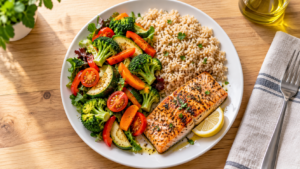
To lose weight, you generally need to take in fewer calories than you use. That does not require an extreme or trendy diet. Mayo Clinic’s guidance centers on plant-based foods, which tend to be lower in calories and higher in fiber, and fiber helps you feel full. Its practical suggestions include:
- Aim for at least four servings of vegetables and three servings of fruit daily.
- Choose whole grains, such as brown rice, barley, and whole-wheat bread and pasta, over refined grains.
- Use healthy fats such as olive oil, avocados, and nuts, but watch portions because they are calorie-dense.
- Limit foods and drinks with added sugar, such as desserts and soda.
- Favor fresh foods over heavily processed ones, which tend to carry more fat, sugar, or salt.
Mayo Clinic also recommends eating mindfully: focus on your food instead of the TV or phone, so you notice when you are full.
Does the type of diet matter? Less than the internet suggests. The dietary review found that, apart from creating an energy deficit, there seems to be no significant difference between diets built around different balances of fat and carbohydrate. It also concludes that the best diet for weight management is one a person can maintain in the long term. The review notes that a Mediterranean-style pattern, rich in vegetables, fruit, and healthy fats, showed strong evidence for weight loss and heart-health markers in the research it summarized.
There is no single “worst” food. People often ask about the worst carb for belly fat or the number one food for weight gain. Foods high in added sugar and refined starch are easy to overeat, and that is a reasonable thing to watch. But none of the sources reviewed for this article identify one carb or food as uniquely responsible for fat around the middle. Overall pattern, portions, and total intake matter more than any single item.
Strategy 3: Move More, Consistently
Mayo Clinic notes you can lose weight without exercise, but it is harder. Regular activity helps burn calories and also lifts mood, lowers blood pressure, and helps sleep. Studies cited by Mayo show that people who keep weight off over the long term tend to be regularly active.
The 1998 NHLBI evidence report found that combining a reduced-calorie diet with more physical activity produced greater weight loss than either alone, and improved fitness too. Mayo Clinic’s current recommendations are:
- Work up to at least 30 minutes of aerobic activity most days, such as brisk walking. Some people may need more to lose weight and keep it off.
- Do strength training at least twice a week, using weights, resistance bands, or bodyweight moves like push-ups.
- Add everyday movement: take the stairs, park farther away, or stand while on calls.
The CDC adds that trying a variety of activities, such as walking, swimming, tennis, or group classes, helps you find what you enjoy, and you are more likely to stick with what you enjoy.
What about step counts? People often ask how many steps it takes to lose a set amount of weight. The sources reviewed here do not give a target number of steps for weight loss. A practical approach is to measure your current daily average and build up gradually rather than chasing a number someone else set.
Can you target belly fat? Trials reviewed in the NHLBI report found that exercise alone reduced abdominal fat only modestly or not at all, while diet combined with activity did somewhat better. Abdominal exercises strengthen those muscles, but the body does not draw fat only from the area you train. Steady activity, strength training, and a moderate calorie deficit reduce overall body fat, which can include fat around the middle over time.
Strategy 4: Protect Sleep and Manage Stress
Sleep and stress are easy to overlook, but the CDC lists both as part of a healthy weight-loss lifestyle. Stress can push people toward eating for comfort, and poor sleep makes it harder to stay consistent with everything else.
Mayo Clinic asks readers to reflect on whether they use food to cope with stress and whether they need support learning other coping methods. If they do, it suggests talking with a healthcare professional. Practical steps from the CDC include regular bed and wake times, avoiding caffeine late in the day, and turning off screens at least 30 minutes before bed.
Strategy 5: Find Support
Weight loss is rarely easier alone. The CDC suggests recruiting family, friends, coworkers, or neighbors, and considering a structured program or a professional such as a nutrition or weight-loss specialist. Mayo Clinic advises picking supporters who encourage you and never shame you. The NHLBI report also found that behavior therapy added to diet and activity helped people lose weight in the short term, and that no single behavioral technique appeared better than another.
If you prefer privacy, both CDC and Mayo point to self-tracking: journaling or using an app to log food, activity, and weight, then reviewing the results and adjusting.
Strategy 6: Plan for Setbacks and Keeping the Weight Off
Everyone has off days. Both the CDC and Mayo Clinic say setbacks are expected. The advice is to get back on track as soon as you can and work out how to prevent the same situation next time, not to give up. Review your goals regularly: keep what works, change what does not, and add a new goal once you consistently meet one. Non-food rewards, such as a sports outing with friends, can keep you motivated.
Maintenance deserves its own plan. The NHLBI report found that lost weight is usually regained unless a maintenance program of diet, activity, and behavior support continues. The dietary review makes a related point: the best approach is one you can sustain long term. Treat the habits above as a way of life, not a temporary project.
When Medical Support Makes Sense
Lifestyle changes are the foundation, but they are not the only option. The CDC says a healthcare provider can discuss referral to a registered dietitian, clinical or community programs, federally approved medications or devices, or bariatric (weight-loss) surgery.
Consider talking with a professional if:
- You have a medical condition, or take medicines that may affect your weight.
- You have tried lifestyle changes and are not seeing results.
- You are unsure what a safe pace or eating plan looks like for you.
- You are considering a prescription medication or procedure.
In the U.S., that might be a primary care provider. In Canada, a family doctor or registered dietitian. In the UK, a GP. Questions worth asking: Could any of my medications affect my weight? What goal is realistic for me? Would a dietitian or structured program help? Are medical treatments appropriate in my case?
For more on medications, see our guides on weight loss medications explained and the ultimate guide to weight loss drugs. For quick everyday ideas, try our 10 effective weight loss tips.
Weight Loss Strategies at a Glance
| Strategy | What it involves | Why it helps |
|---|---|---|
| Realistic pacing | About 1–2 pounds a week; start with a goal such as 5% | Gradual loss is more likely to be maintained (CDC) |
| Tracking | Food, activity, sleep, and stress diaries | Reveals patterns and easy first changes |
| Whole-food eating | More vegetables, fruit, whole grains; less added sugar | Lower calories, more fiber and fullness (Mayo Clinic) |
| Regular activity | 30 minutes of aerobic activity most days, plus strength training twice a week | Burns calories; diet plus activity beats either alone (NHLBI) |
| Sleep and stress care | Consistent sleep routine, healthy coping tools | Makes consistency easier (CDC) |
| Support | Friends, programs, professionals | Accountability and guidance |
| Medical options | Discussed with a provider | May suit some people alongside lifestyle changes (CDC) |
Frequently Asked Questions About Weight Loss
Is it possible to lose 10 pounds in a month?
Some people do lose that much, especially early on or at a higher starting weight. But 10 pounds a month is faster than the 1 to 2 pounds a week the CDC and Mayo Clinic describe as a sustainable pace, and the CDC says faster loss is less likely to be kept off. If you are aiming for a big change, discuss a safe pace with a healthcare professional.
Is it healthy to lose 2 pounds a week?
Two pounds a week is the top of the range recommended by the CDC and Mayo Clinic. It may be reasonable for some people, but it is not something to force. Very rapid loss, or losing weight without trying, is worth raising with a healthcare provider.
Will I go down a size if I lose 10 pounds?
It depends on your starting weight, height, body composition, and where you tend to lose. Clothing sizes also vary by brand. Measurements, how your clothes fit, and your energy and fitness can be better signs of progress than the scale alone.
What is the most successful weight loss strategy?
Research points to combining habits, not one trick. The NHLBI evidence report found the most successful approach combined a reduced-calorie diet, more physical activity, and behavior support. The dietary review adds that the best plan is one you can maintain over the long term.
Is it true that exercise won’t help me lose much fat?
Diet often has the larger effect on the scale because it is easy to eat back the calories you burn, and the NHLBI report found that activity alone produced modest weight loss. But exercise still matters. Mayo Clinic says weight loss is harder without it, and people who keep weight off tend to stay active. Exercise also improves heart health, mood, and sleep.
Why am I exercising but not losing weight?
Common reasons include eating more than you realize, building muscle, water retention, poor sleep, and stress. The CDC also notes medicines, medical conditions, hormones, genes, and age can affect weight. A few days of food tracking is a good first step. If nothing changes after a few weeks, ask your provider.
What is blocking my weight loss?
There is rarely a single cause. It could be portion sizes, drinks, sleep, stress, activity level, or a medication or condition. Tracking food, movement, and sleep can show where to adjust, and a healthcare professional can rule out medical factors.
At what age is it hardest to lose weight?
There is no single age. Age is one of the factors the CDC lists as affecting weight management, and muscle mass generally declines without strength training. The NHLBI report found that age alone should not rule out treatment for older adults, and that weight loss improved heart-disease risk factors in older and younger adults alike, provided the plan protects nutrition and bone health. Older adults should plan changes with a healthcare professional.
What is the 3-3-3 rule (or the 30-30-30 rule) for weight loss?
These are social-media-style rules, and different versions circulate. None of the sources reviewed for this article describe them as recognized clinical guidelines. If a rule encourages regular meals, movement, or better sleep, those habits are sound, but the rule itself is not what makes them work. Judge any “rule” by whether it fits the principles above.
What is the “Japanese trick” to lose weight?
There is no single established “Japanese trick.” Online, the phrase attaches to a range of habits, and none are backed by the sources here. Be cautious with any claim of a secret method.
How can I mimic Ozempic naturally?
No food, drink, or supplement is proven to copy how prescription medications like semaglutide work. What you can do is follow habits that support fullness and steady loss: fiber-rich foods, adequate protein, regular movement, and good sleep. Prescription medications are for a healthcare provider to assess based on your health, and the CDC lists federally approved medications as one option to discuss with one.
Is it okay to skip meals to lose weight?
Skipping meals is not required for weight loss, and the general guidance reviewed here does not recommend it. The dietary review notes that skipping breakfast is associated with overweight and obesity, though association does not prove cause. It also reports that intermittent fasting has effects comparable to daily calorie restriction, but that long-term sustainability and health effects are not well known. If you are considering fasting, especially with a health condition or medication, check with a professional first.
Is my true weight in the morning or at night?
Neither is more “true.” Weight naturally shifts through the day with food, fluids, and activity. If you weigh yourself, do it under the same conditions each time, such as first thing in the morning, and look at the trend over weeks.
The Takeaway
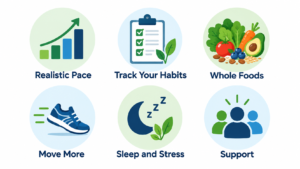
The strategies for weight loss with the strongest support are unglamorous: a realistic pace, a food pattern centered on whole foods, regular activity, enough sleep, stress management, and people who back you up. Pick two or three specific actions this week, track how they go, and adjust. If progress stalls or you have health concerns, involve a healthcare professional so your plan fits your situation.
Sources
- Centers for Disease Control and Prevention. Steps for Losing Weight. Healthy Weight and Growth. Last updated January 17, 2025.
- Mayo Clinic Staff. Weight loss: 6 strategies for success. June 22, 2024.
- Kim JY. Optimal Diet Strategies for Weight Loss and Weight Loss Maintenance. J Obes Metab Syndr. 2020;30(1):20–31. doi:10.7570/jomes20065.
- NHLBI Obesity Education Initiative Expert Panel. Summary of Evidence-Based Recommendations. In: Clinical Guidelines on the Identification, Evaluation, and Treatment of Overweight and Obesity in Adults: The Evidence Report. National Heart, Lung, and Blood Institute; 1998. (Older report; used for long-standing findings on combining diet, activity, and behavior support.)
Further Reading and Resources
- Healthy strategies for successful weight loss and weight maintenance: a systematic review — Canadian Society for Exercise Physiology (CSEP), 2014.
- Treatment for overweight and obesity — NIDDK, on how health care professionals can help you adopt lifestyle changes.
- Choosing a safe and successful weight-loss program — NIDDK.
- Prescription medications to treat overweight and obesity — NIDDK.
- Healthy Eating for a Healthy Weight — CDC.
- Tips for Physical Activity and Your Weight — CDC.
- What you should know about popular diets — Nutrition.gov, on evaluating diet and product claims.
- 10 effective weight loss tips — Care Digitally.
- Weight loss medications explained — Care Digitally.
- Ultimate guide to weight loss drugs — Care Digitally.