Introduction:
Fitness trackers, smartwatches, and other wearable health devices have become part of everyday life for many people. They count steps, estimate calories, track heart rate, and nudge you to stand up when you have been sitting too long. But a practical question remains: does wearing one actually make you fitter, or does it just give you more numbers to look at?
The research offers a fairly encouraging answer, with some important limits. This article walks through what large reviews and studies have found, where the evidence is weaker than the marketing suggests, and how to use wearable health devices for fitness in a way that is more likely to pay off.
The Short Answer
For most people, wearing an activity tracker is associated with moving more, but the size of the benefit depends on how the device is used.
- Steps and activity go up. A large 2022 review of reviews found that trackers increased physical activity by roughly 1,800 steps per day on average.
- The effect is modest, not magical. Weight changes were small, and many other health measures showed little or no meaningful change.
- Support matters. In older adults, trackers paired with coaching or goal-setting did better for moderate-to-vigorous activity than trackers used alone.
- Staying power is mixed. The 2022 review found gains held for at least six months, but step gains were smaller over several years, and a review in older adults found that many people stop wearing their device within months.
What Counts as a Wearable Health Device?
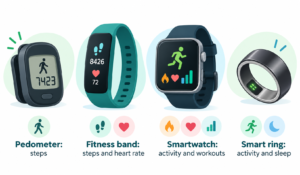
A wearable health device is any piece of technology worn on the body that collects information about your activity or physiology. When people search for wearable health devices for fitness, they are usually thinking of one of the following.
| Device type | What it typically measures | Common use |
|---|---|---|
| Clip-on pedometer | Steps, using a simple motion sensor | Basic step counting at a low cost |
| Fitness band or tracker | Steps, movement intensity, often heart rate and sleep | Daily activity goals and trends |
| Smartwatch | Activity, heart rate, workouts, plus phone features | All-in-one tracking and notifications |
| Chest strap heart rate monitor | Heart rate during exercise | Training intensity during workouts |
| Smart ring | Activity, heart rate, sleep | Low-profile everyday tracking |
Research on this topic often separates trackers by the sensor inside. Pedometers mainly count steps and are inexpensive. Accelerometers measure movement forces and are generally treated as the standard for estimating activity levels and intensity, according to a 2023 review in Digital Health. Most modern fitness bands and smartwatches use accelerometers.
What the Research Says About Wearable Health Devices and Fitness
Rather than relying on a single study, it helps to look at several types of evidence: a review of many reviews, a focused review of controlled trials in older adults, and a large real-world study of long-term Fitbit users.
The Big Picture: A Review of 39 Reviews
In 2022, researchers publishing in The Lancet Digital Health combined the findings of 39 systematic reviews and meta-analyses (searches ran to April 2021) covering 163,992 participants of all age groups, including both healthy people and people with health conditions. Their umbrella review of wearable activity trackers concluded that:
- Trackers improved physical activity, body composition, and fitness.
- The improvements equated to about 1,800 extra steps per day, about 40 more minutes of walking per day, and a reduction of about 1 kilogram (roughly 2 pounds) in body weight.
- Moderate-to-vigorous activity rose by about 6 minutes per day.
- The benefit appeared across age groups and in both clinical and non-clinical populations.
- Gains appeared to hold for at least six months. One included review found about 1,100 extra steps per day at 4 to 6 months and about 500 extra steps per day up to 4 years.
The authors judged the evidence strong enough to recommend activity trackers, at least as an add-on to programs that aim to increase physical activity. Effects on blood pressure, cholesterol, blood sugar markers, quality of life and pain were typically small and often not statistically significant. One caution: when the authors rated the quality of the 39 reviews, only 3 were high or moderate confidence and 34 were rated critically low, although results were similar across the quality ratings. In plain terms, trackers seem to get people moving more, but they are not a shortcut to dramatic changes in other health markers.
Older Adults: Real Gains, With Caveats
A 2023 systematic review and meta-analysis in Digital Health focused on adults over 60. It pooled 45 randomized controlled trials involving 7,144 participants. You can read the full analysis of wearable activity trackers in older adults in the journal.
The findings were encouraging:
- Trackers increased daily steps by roughly 1,430 steps compared with control groups.
- Weekly moderate-to-vigorous activity rose by roughly 38 minutes.
- Total daily activity increased modestly, by roughly 17 minutes, and sitting time fell by a very small amount, about 7.5 minutes per day on average, and the range of possible values for that figure included no change.
The same review also contains useful warnings:
- Trackers alone were not enough for more intense exercise. When trackers were used by themselves, there was no clear effect on moderate-to-vigorous activity. When combined with things like counseling, goal setting, or exercise programs, the effect was larger.
- Shorter programs looked better than longer ones for intensity. The authors linked this to people using their devices less over time. They cited a survey suggesting that over half of users stopped wearing trackers within six months.
- The certainty of the evidence was limited. The authors rated confidence in the step and moderate-to-vigorous activity results as very low and low, respectively, citing study design limits and large differences between studies. Results should be read as promising, not settled.
- Results varied by age. Gains in moderate-to-vigorous activity were larger in people under 70 than in those 70 and older, although step gains were similar.
Real-World Data: What Long-Term Tracking Suggests
A January 2026 study in Communications Medicine, using data from the National Institutes of Health’s All of Us Research Program, took a different approach. Researchers linked at least six months of Fitbit data from 22,019 participants to their electronic health records. The study on wearable-measured activity and chronic disease risk found that higher activity was associated with lower risk of several conditions. For example, each 2,000-step increase in daily steps was associated with a lower likelihood of developing obesity, type 2 diabetes, and major depressive disorder. More sedentary time was associated with higher risk for several of the same conditions.
This kind of study is valuable because it tracks people over long periods in real life. But it has an important limit: it shows association, not proof of cause and effect. The authors noted that Fitbit users are likely to be more health-conscious than the general population, that factors such as diet and socioeconomic status were not captured, and that consumer devices can be less accurate for intensity, heart rate, and calorie estimates. Put simply, the study supports the idea that moving more is linked to better health, but it cannot show that buying a tracker caused anyone’s health to improve.
How the Evidence Compares
| Source | Who was studied | Main finding | Key limitation |
|---|---|---|---|
| Lancet Digital Health (2022) umbrella review | 39 reviews, 163,992 participants, all ages | About 1,800 more steps and about 40 more minutes of walking per day; about 1 kg lower weight | Most included reviews were rated low quality; other health outcomes showed small, often non-significant effects |
| Digital Health (2023) meta-analysis | 45 trials, 7,144 adults over 60 | About 1,430 more steps per day; about 38 more weekly minutes of moderate-to-vigorous activity | Low to very low certainty of evidence; benefits faded with long-term use |
| Communications Medicine (2026) cohort study | 22,019 Fitbit users in the U.S. | Higher steps and activity linked to lower risk of several chronic conditions | Observational; cannot prove cause and effect |
Why Wearable Health Devices Might Help
The research does not prove exactly why trackers work, but the likely reasons are practical rather than mysterious. Researchers describe trackers as tools that record activity objectively and give feedback that helps people work toward activity goals.
In everyday terms, a wearable can help by:
- Making invisible habits visible. A daily number shows what you actually do, which gives you something concrete to work with.
- Turning vague goals into specific ones. “Walk more” is easy to ignore. A target you can see building through the day is harder to ignore.
- Providing feedback and prompts. Reminders to move after long stretches of sitting may help reduce sedentary time, a behavior linked in the real-world data above to higher chronic disease risk.
- Encouraging consistency. Seeing a streak or weekly trend can support routine, which matters more than any single workout.
None of this works if the device sits in a drawer. The most useful feature of any tracker is the one you will keep using.
The Limits Worth Knowing About
Wearable health devices for fitness are helpful tools, not guarantees. A few honest limitations are worth keeping in mind.
Accuracy varies. Steps are generally easier to measure than calorie burn, heart rate during hard exercise, or exercise intensity. The 2026 study’s authors specifically noted that consumer devices have documented limitations in estimating intensity, heart rate, and energy expenditure. Treat these numbers as estimates and look for trends over time rather than fixating on a single day’s reading.
Motivation can fade. The older-adult review linked shorter programs to better activity gains, partly because use declines over time. If you notice your interest dropping, changing your goal, joining a walking group, or switching up your routine may help more than buying a newer device.
Numbers can become a pressure. The 2022 review notes that critics have raised concerns that trackers might fuel obsessive behaviors and eating disorders. That review looked at effectiveness and did not settle the question. If tracking starts to cause anxiety, guilt, or unhealthy habits around food or exercise, it is reasonable to take a break from the device and talk with a healthcare professional.
Evidence is still developing. Even strong reviews note variability between studies and, in some cases, low certainty. Most of the reviews in the 2022 umbrella review were rated critically low confidence on a standard quality checklist. The overall direction is positive, but exact results will differ from person to person.
Privacy deserves a look. Wearables collect personal data, often stored by the manufacturer’s app. Before you sync, check what is shared, who can see it, and how to delete it.
How to Get More Fitness Value From a Wearable
These are general approaches that line up with what the research found, not individual medical advice.
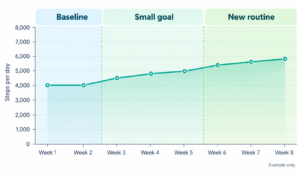
- Start with your baseline. Wear the device for about a week without changing anything, then use that average as your starting point.
- Set small, specific goals. A modest, gradual increase is easier to sustain than a sudden jump. The studies above saw gains of roughly 1,400 to 1,800 steps per day, not tens of thousands.
- Pair the device with support. In older adults, trackers combined with counseling, goal setting, or exercise programs did better for moderate-to-vigorous activity than trackers alone. A friend, family member, group class, or coach can serve a similar purpose.
- Watch sitting time, not just steps. Long periods of inactivity were linked to higher chronic disease risk in the large real-world study. Short movement breaks count.
- Review your trends monthly. Look for patterns, such as which days are hardest, rather than judging yourself daily.
- Choose comfort and simplicity. The best device is one you will wear consistently. Battery life, fit, and how easy the app is to use all affect that.
Choosing a Device: What to Think About
There is no single best wearable for everyone, and the research reviewed here does not rank brands. A more useful approach is to start with your own needs.
- Your main goal: Basic step counting, workout tracking, and heart rate training each call for different features.
- Sensor type: Accelerometer-based devices are generally considered more accurate for activity than basic pedometers, though both increased steps in the older-adult review.
- Comfort and daily wear: Devices worn all day give a fuller picture than ones you remove often.
- Budget: Research on trackers is largely built on affordable consumer devices, so more expensive does not automatically mean more effective.
- Privacy settings: Look at what data is collected and how you can control it.
- Medical features: If you are interested in heart rhythm or other health alerts, ask a healthcare professional how to interpret them. A wearable can flag a pattern, but it cannot diagnose a condition.
When to Talk to a Healthcare Professional
A wearable can motivate you, but it is not a substitute for medical care. Consider checking with a doctor, nurse, or pharmacist before starting a new exercise program if you have a heart condition, other chronic health concerns, are pregnant, have been inactive for a long time, or have pain or limited mobility.
Seek urgent care for symptoms such as chest pain or pressure, severe shortness of breath, fainting, or sudden weakness, regardless of what your device shows. In the United States and Canada, call 911. In the United Kingdom, call 999.
If your device sends an alert or shows an unusual reading, a useful conversation starter with your clinician is: “My device showed this pattern. Does it mean anything for me, and what should I watch for?”
Frequently Asked Questions
Are wearable health devices worth it for fitness?
For many people, yes, as a tool for building activity habits. Large reviews found that trackers increased steps and walking time and were associated with small reductions in body weight. They work best when you actually use them, set realistic goals, and combine them with other support. They are not necessary for being fit, and they will not replace regular movement.
Do health trackers really work?
Trackers appear to work for increasing physical activity, according to the 2022 umbrella review in The Lancet Digital Health. The effects on other health measures were generally small. “Work” here means helping you move more, not guaranteeing specific health outcomes.
What are examples of wearable health devices?
Common examples include fitness bands, smartwatches, clip-on pedometers, chest strap heart rate monitors, and smart rings. Studies in the research cited here involved devices from several manufacturers, including Fitbit, Garmin, and Polar models, along with simple pedometers.
What is the best wearable device for fitness?
There is no single best option. The right choice depends on your goals, budget, comfort, and which features you will actually use. For general activity tracking, a simple band or watch that you will wear every day is often more useful than a feature-heavy device you stop wearing.
Which wearable is the most accurate?
The research summarized in this article does not name a most accurate brand. In general, devices tend to measure steps more reliably than calorie burn or exercise intensity. Accelerometer-based trackers are considered the standard for measuring activity in research, compared with basic pedometers.
What are the downsides of wearable technology?
The main downsides are accuracy limits for some measurements, declining use over time, privacy considerations, and, for some people, added stress or an unhealthy focus on numbers. If tracking begins to feel stressful, consider taking a break.
Can wearable devices help older adults stay active?
Evidence from controlled trials suggests they can. A 2023 meta-analysis of adults over 60 found increases in daily steps and weekly moderate-to-vigorous activity, with better results when trackers were combined with other supports like counseling or goal setting. The certainty of the evidence was limited, so results will vary.
The Bottom Line
Wearable health devices can improve fitness in a realistic, modest way: by helping people see their habits, set goals, and move a bit more each day. The best evidence points to gains of roughly 1,400 to 1,800 steps per day, and trackers appear most useful when paired with goals and support rather than used alone.
They are not a cure-all. Accuracy varies, motivation fades, and the strongest long-term findings are associations rather than proof. A good approach is to treat a wearable as a coach’s clipboard, not the coach: use it to notice patterns, pick one small goal, and build a routine you can maintain. If you have health concerns, bring your questions to a healthcare professional.
For more on choosing and using these devices, see our wearable health devices guide and our article on wearable health devices for fitness enthusiasts.
Sources
- Ferguson T, Olds T, Curtis R, et al. Effectiveness of wearable activity trackers to increase physical activity and improve health: a systematic review of systematic reviews and meta-analyses. The Lancet Digital Health, August 2022.
- Wu S, Li G, Du L, et al. The effectiveness of wearable activity trackers for increasing physical activity and reducing sedentary time in older adults: a systematic review and meta-analysis. Digital Health, May 2023.
- Hou Y, Cui E, Lim K, et al. Association of chronic disease risk and physical activity measured by wearable devices in the All of Us program. Communications Medicine, January 2026.
This article is for general information and education only. It is not medical advice and does not replace guidance from a qualified healthcare professional.