Introduction

Picture this: it’s 11 PM, and something feels off. Maybe it’s a dull ache in your chest, an unusual rash, or a nagging cough that’s overstayed its welcome. Before you’ve even reached for your phone to call your doctor, your fingers are already typing symptoms into a search bar. Within seconds, you’ve self-diagnosed everything from acid reflux to a rare tropical disease you’ve never heard of. Sound familiar?
You’re not alone. Millions of people across the United States, Canada, and the United Kingdom turn to the internet for health answers every single day. The internet has democratized access to medical knowledge in ways that would have seemed unthinkable two decades ago. But here’s the rub not all of that knowledge is created equal. Some of it is brilliant; some of it is dangerously wrong. Learning how to navigate online health information with skill and discernment isn’t just a nice-to-have skill anymore. It’s a modern health essential.
This guide is your roadmap through the maze.
Why Online Health Information Is Both a Blessing and a Minefield
Let’s be clear about something: the internet, used well, is a genuinely powerful health ally. It can help you understand a diagnosis your doctor gave you, compare treatment options, research medications, or find community with others managing similar conditions. The challenge is that it can also send you spiraling into unnecessary anxiety or, worse, lead you to ignore a serious symptom because a random blog told you it was nothing.
The National Center for Complementary and Integrative Health (NCCIH) has noted that the quality of health information online varies enormously from peer-reviewed medical research to pure fiction dressed up in clinical-sounding language. Knowing the difference is what separates an empowered patient from a misinformed one.
So how do you start finding health information online that you can actually trust?
Where to Start: The Gold Standard Sources for Online Health Information
Government and Institutional Websites (.gov, .edu, .org)
Think of reputable health websites the way you’d think about sourcing ingredients for a fine meal. You wouldn’t grab mystery meat from an unmarked stall when a trusted butcher is right next door. The same logic applies here.
The most reliable sources for online health information are typically government health agencies and established academic medical institutions. In the US, that means the National Institutes of Health (NIH), the Centers for Disease Control and Prevention (CDC), and MedlinePlus. In Canada, Health Canada and Healthwise (available through provincial health services) are your go-to anchors. In the UK, the NHS website (nhs.uk) is arguably the gold standard for public health information clear, evidence-based, and regularly updated.
As the NCCIH recommends, starting your health search with trustworthy sources is the most important first step. Their guidance emphasizes that looking for websites maintained by federal agencies, medical schools, or well-established health organizations gives you the strongest foundation.
Academic Medical Centers
University-affiliated hospitals and medical schools often publish patient education material that rivals anything you’d find in a physician’s office. Think Johns Hopkins Medicine, Mayo Clinic, Cleveland Clinic, or the University of Florida Health system all of which maintain patient-facing content written and reviewed by actual specialists. UF Health’s guidance on online health information makes an excellent point: the best medical websites clearly identify who wrote the content and when it was last reviewed.
What Is the Best Online Medical Site? A Practical Breakdown
This is perhaps the most common question people have when they start exploring health information online, and it deserves a thorough answer.
The honest truth is that no single website covers everything perfectly but several come remarkably close for different purposes. Here’s a breakdown:
| Website | Best For | Country Focus | Peer-Reviewed? |
|---|---|---|---|
| NIH / MedlinePlus | General health topics, drug information | US | Yes |
| CDC | Disease prevention, public health data | US | Yes |
| NHS UK | Symptoms, conditions, treatment options | UK | Yes |
| Health Canada | Drug approvals, public health guidelines | Canada | Yes |
| Mayo Clinic | Condition overviews, symptom checkers | US/Global | Yes |
| Cleveland Clinic | In-depth medical articles | US/Global | Yes |
| Healthline | Accessible, detailed condition guides | Global | Medically reviewed |
| WebMD | Symptom checker, drug info | US/Global | Medically reviewed |
| PubMed | Peer-reviewed research papers | Global | Yes (primary research) |
Is WebMD or Healthline More Reliable?
Both WebMD and Healthline have earned their place in the digital health ecosystem, but with important distinctions. WebMD has been around since 1996 and has a vast database of condition information, though critics note that its symptom checker can be alarmist. Healthline, on the other hand, has invested heavily in medical editorial review processes and often presents information in a more digestible, reader-friendly format.
For most people seeking general health guidance, both are reasonable secondary sources but neither should replace a conversation with your physician. Think of them as informed friends who happen to have read a lot of medical literature, not as licensed practitioners.
What Site Is Better Than WebMD?
If you’re looking for something with more clinical depth, Mayo Clinic consistently ranks as one of the most trusted medical websites in the world. Its content is written by physicians, reviewed by specialists, and presented without the ad-heavy noise that can make WebMD feel overwhelming. For raw research, PubMed (maintained by the National Library of Medicine) gives you access to millions of peer-reviewed studies though it does require some comfort with scientific language.
How Reliable Is Online Health Information, Really?
Here’s where we need to have an honest conversation. According to research highlighted by NIH News in Health, not all health websites are created equal, and the consequences of consuming inaccurate information can range from mild inconvenience to genuine medical harm.
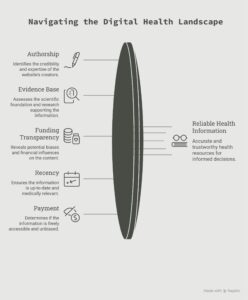
The reliability of online health information depends almost entirely on the source. A peer-reviewed journal article from JAMA is categorically different from a wellness influencer’s Instagram caption, even if they’re both commenting on the same topic. The key variables are authorship, evidence base, funding transparency, and recency.
The NCCIH’s comprehensive framework for evaluating online resources outlines several critical questions you should always ask:
- Who runs this website? Is it a government agency, a hospital, a nonprofit or an anonymous blogger?
- Who is paying for it? Advertising-funded sites may have financial incentives to push certain products or treatments.
- What is the evidence? Is the information based on scientific research, expert consensus, or personal anecdotes?
- When was it last updated? Medical guidelines change. Information from 2014 may be outdated or even dangerous.
- Does it ask you to pay for anything? Legitimate health information is typically free.
Red Flags for Doctors (and Health Websites): How to Know When Not to Trust
The phrase “red flags” in medicine typically refers to symptoms that warrant urgent attention. But there’s an equally important category of red flags that apply to health websites and, by extension, to online health advice in general.
Red Flags on Health Websites
Watch out for these warning signs when evaluating any source of online health information:
- Sensational headlines that promise miracle cures. If a website claims to have the one secret treatment that doctors don’t want you to know, close the tab.
- No author attribution. Reliable health content identifies who wrote it and what their credentials are.
- No date of publication or last review. Undated medical content is a liability, not a resource.
- Heavy reliance on testimonials. Personal stories are compelling, but they are not evidence.
- Pushing supplements or products. If every article somehow ends with a recommendation to buy something, that’s a conflict of interest, plain and simple.
- No references to scientific literature. Trustworthy health writing cites its sources.
University of North Carolina Student Wellness provides excellent guidance on this front, emphasizing that reliable health resources always connect readers back to credible, verifiable sources rather than asking them to take information on faith.
What Are Red Flags for Doctors? Applying the Same Logic
Just as you’d scrutinize a health website, it’s worth knowing the red flags that signal a healthcare provider might not be serving your best interests. These include dismissing your concerns without explanation, discouraging second opinions, or being unable to explain treatment rationale in plain language. A good doctor online or in person welcomes questions and makes you feel informed, not intimidated.
The Rise of Virtual Healthcare: Can Online Doctors Be Trusted?
One of the most significant shifts in healthcare over the past decade has been the explosive growth of telehealth and virtual medical services. In Canada particularly, services like Telehealth Ontario have become mainstream and yes, telehealth is legal and regulated in Canada, with OHIP covering many virtual consultations for Ontario residents.
Can You Get Antibiotics or Prescriptions from a Virtual Doctor?
This is a genuinely common question, and the answer is: yes, with important caveats. Licensed telehealth providers think Teladoc, Maple, or Babylon Health in Canada can evaluate symptoms, make diagnoses, and in many cases write prescriptions. So can a Teladoc prescribe certain medications? Absolutely. Teladoc physicians are fully licensed medical professionals who operate within the same regulatory frameworks as in-person doctors. They can prescribe antibiotics for conditions like strep throat or urinary tract infections after a proper virtual consultation.
However, there are limitations. Controlled substances, complex conditions, and situations requiring physical examination fall outside what virtual doctors can safely address. The key is using telehealth as a complement to traditional care, not a replacement for it.
What Are the Disadvantages of Using Telehealth?
The convenience of virtual care comes with genuine trade-offs. Physical examination is impossible via video, which limits diagnostic accuracy for conditions requiring touch, smell, or sophisticated equipment. The absence of in-person relationship-building can also make it harder to discuss sensitive mental health issues. And while telehealth is increasingly covered by insurance in the US and by provincial plans in Canada, coverage gaps remain particularly for specialty care.
Navigating Health Records Online: What You Should Know
In Canada: EMR Systems and Digital Health Records
Canada’s healthcare system has been steadily digitizing, and understanding how electronic medical records (EMR) work can help you take a more active role in managing your health. The most widely used EMR systems in Canadian clinical settings include OSCAR Pro, Telus Health, and Epic (used in several large hospital networks, particularly in Ontario and British Columbia).
Ontario residents can access their health records through platforms like MyChart (where available) or by requesting records through their care provider. For those wondering how to get medical records online for free in Ontario, the province’s eHealth Ontario initiative is the official starting point.
Is There a Canadian Version of HIPAA?
Yes Canada’s equivalent to the American HIPAA (Health Insurance Portability and Accountability Act) is PIPEDA (Personal Information Protection and Electronic Documents Act) at the federal level, with provincial legislation like Ontario’s PHIPA (Personal Health Information Protection Act) adding an additional layer of protection. These laws govern how your health data can be collected, used, and shared by healthcare providers and digital health platforms.
How to Evaluate Any Piece of Online Health Information: A Step-by-Step Framework
Let’s bring this all together into something actionable. The next time you find yourself deep in a health research rabbit hole, run through this checklist:
Step 1: Check the source. Is it a government agency, academic medical center, or reputable health organization? If so, proceed with confidence. If not, verify carefully.
Step 2: Look for authorship and credentials. Who wrote this? Are they a licensed medical professional? Do they have relevant expertise?
Step 3: Check the date. Was this published or reviewed within the last two to three years? Medical guidelines evolve, and outdated information can be misleading.
Step 4: Follow the money. Is the website funded by pharmaceutical companies, supplement brands, or other entities with commercial stakes in your health choices?
Step 5: Cross-reference. Does this information match what you’d find on the NIH, NHS, or Mayo Clinic? Consensus across multiple credible sources is a strong positive signal.
Step 6: Bring it to your doctor. The best thing online health information can do is help you ask better questions at your next appointment not replace that appointment entirely.
The Best Health Information Resources by Country: A Quick Reference
United States
- NIH MedlinePlus: medlineplus.gov
- CDC: cdc.gov
- Mayo Clinic: mayoclinic.org
- Cleveland Clinic: my.clevelandclinic.org
Canada
- Health Canada: canada.ca/en/health-canada
- HealthLink BC (for BC residents): healthlinkbc.ca
- Telehealth Ontario: health.gov.on.ca
- Canadian Cancer Society: cancer.ca
United Kingdom
- NHS: nhs.uk
- NHS Inform (Scotland): nhsinform.scot
- Patient.info: patient.info
- Cancer Research UK: cancerresearchuk.org
Frequently Asked Questions About Online Health Information
Where do people get health information online? Most people start with a general search engine like Google, which then directs them to a mix of sources some reliable, some not. The most commonly visited health websites in the US are WebMD, Healthline, Mayo Clinic, and government sites like CDC.gov and NIH.gov. In the UK, nhs.uk dominates as the primary health reference, while Canadians frequently consult provincial health portals and Health Canada.
What online doctors are legitimate? Legitimate online doctors are licensed, board-certified physicians practicing through regulated telehealth platforms. In the US, services like Teladoc, MDLive, and PlushCare operate under state medical board oversight. In Canada, Maple, Dialogue, and Telehealth Ontario are regulated by provincial medical colleges. Always verify that the platform requires physician licensure and that practitioners are identified by name and credentials.
Can I trust everything I read on the internet about health? Absolutely not and that’s not pessimism, it’s just the reality of an unregulated information environment. The internet has no editorial gatekeepers. Anyone can publish anything, regardless of accuracy. Your job as a health-information consumer is to apply the same critical thinking you’d apply to any important decision: check the source, verify the evidence, and consult a professional when the stakes are high.
What is the most reliable website for health information? For the US, NIH’s MedlinePlus (medlineplus.gov) is widely regarded as the gold standard for general health consumers. For UK residents, nhs.uk is the equivalent. In Canada, Health Canada and provincial health portals provide government-backed, evidence-based information. Mayo Clinic is an excellent global resource for in-depth condition information reviewed by specialists.
Is WebMD a reliable source? WebMD is a legitimate, medically reviewed resource that can serve as a useful starting point. However, its symptom checker has a reputation for over-suggesting serious conditions, and its content is commercially funded through advertising. Use it as a first reference, but verify important health decisions against more authoritative sources like the NIH or your own healthcare provider.
A Final Word: Information Is Power But Wisdom Knows Its Limits
There’s something quietly extraordinary about living in an era where a person in Toronto, New York, or London can access the same medical knowledge that was once locked inside specialist textbooks. Online health information, at its best, is a profound equalizer it helps people ask better questions, make more informed decisions, and advocate for themselves in healthcare settings.
But it works best when you approach it with curiosity rather than certainty. The goal of researching your health online isn’t to diagnose yourself or replace your doctor it’s to walk into every medical conversation feeling prepared, informed, and confident. Used that way, the internet becomes less of a minefield and more of a map.
Start with trustworthy sources. Ask hard questions about what you read. Bring your findings to a professional. And remember: the best piece of online health information you’ll ever consume is the one that makes you pick up the phone and call your doctor.
Have a go-to health website that’s helped you navigate a medical question? Share it in the comments — your experience might be exactly what someone else needs today.