Introduction

Picture this: you’ve nailed the corner office, the social calendar is full, and your fitness tracker buzzes with approval every evening. Yet, somewhere beneath the surface, there’s a quiet unease a low hum of anxiety that no amount of productivity hacking seems to silence. Sound familiar?
Here’s the uncomfortable truth that doctors across the US, Canada, and the UK are increasingly vocal about: mental health habits aren’t a luxury reserved for those in crisis. They are the architecture of a well-functioning life and most of us have been neglecting the blueprints. The good news? The interventions that matter most aren’t exotic retreats or expensive therapies. They’re deliberate, repeatable practices you can begin today.
So, what exactly do clinicians, psychiatrists, and GPs actually recommend when the conversation turns to building lasting psychological resilience? Let’s get into it.
What Are Mental Health Habits, Really?
Before we dive into the doctor-approved roster, it’s worth unpacking what we mean. Mental health habits aren’t just “positive thinking” or vague acts of self-care. They’re consistent behavioral patterns things you do (or deliberately stop doing) that directly influence your mood, cognitive function, emotional regulation, and resilience.
According to the American Psychiatric Association, lifestyle choices are profoundly connected to mental health outcomes. The five pillars that emerge repeatedly in clinical guidance include sleep, physical activity, nutrition, social connection, and stress management. Think of these not as separate checkboxes but as interconnected systems like the gears of a watch. When one slips, the others feel it.
The 7 Healthy Mental Health Habits Doctors Swear By
1. Prioritize Sleep Like Your Brain Depends on It Because It Does
If there’s one habit that doctors across specialties will universally champion, it’s sleep. We’re not talking about the glorified hustle-culture “I’ll sleep when I’m dead” approach. We mean 7–9 hours of quality, uninterrupted rest every night.
During sleep, your brain literally cleans itself the glymphatic system flushes out metabolic waste, including proteins linked to cognitive decline. Poor sleep is among the biggest risk factors for depression, anxiety, and impaired decision-making. If you’re regularly running on five hours, no amount of mindfulness apps will compensate.
Doctor’s tip: Keep a consistent sleep schedule even on weekends. Your brain doesn’t understand the concept of “catching up.”
2. Move Your Body: The Most Underrated Antidepressant
There’s mounting clinical evidence that regular physical activity rivals antidepressants in reducing symptoms of mild to moderate depression and it comes with zero prescription co-pays. Exercise triggers a cascade of neurochemical events: endorphins, yes, but also BDNF (brain-derived neurotrophic factor), which essentially acts as fertilizer for your neurons.
According to Headspace’s clinical advisors, even 30 minutes of moderate aerobic exercise five days a week is enough to measurably shift mood and reduce anxiety. Whether it’s a brisk walk through Hyde Park in London, cycling through the streets of Vancouver, or jogging along the Chicago Lakefront consistency beats intensity every time.

3. Master the Art of Social Connection
Loneliness is being called the new public health epidemic and doctors aren’t being dramatic. Chronic social isolation has health consequences comparable to smoking 15 cigarettes a day. Strong social bonds, on the other hand, buffer against stress, boost immunity, and increase longevity.
This doesn’t mean you need a packed social calendar. Quality over quantity matters enormously. Regular, meaningful check-ins with close friends or family members people who actually see you are what the research consistently highlights. For professionals in major cities, this often means being intentional: scheduling coffee, protecting weekends from overwork, and resisting the temptation to substitute scrolling for connecting.
4. Practice Mindfulness and Meditation (Yes, Even If You’re Skeptical)
The science on mindfulness is now robust enough that many NHS trusts in the UK formally offer Mindfulness-Based Cognitive Therapy (MBCT) as a treatment for recurrent depression. In Canada and the US, it’s standard in many psychiatric and primary care practices.
What’s actually happening when you meditate? You’re training the prefrontal cortex the brain’s executive control center to assert authority over the amygdala, the alarm system that triggers anxiety responses. Over time, this rewires your default reaction to stress from panic to pause-and-process.
You don’t need to commit to an hour-long silent retreat. Start with ten minutes daily. Apps like Headspace or Calm can scaffold the practice, but even three slow, deliberate breaths before a stressful meeting counts as habit formation in the right direction.
5. Nutrition: What Are 7 Superfoods for Mental Health?
The gut-brain axis is one of the most exciting frontiers in psychiatric research, and doctors are paying attention. What you eat directly affects neurotransmitter production particularly serotonin, 90% of which is produced in the gut.
Clinicians and nutritional psychiatrists are increasingly recommending a diet rich in:
| Food | Mental Health Benefit |
|---|---|
| Fatty fish (salmon, mackerel) | Omega-3s reduce inflammation and support mood regulation |
| Leafy greens (spinach, kale) | Folate supports dopamine and serotonin synthesis |
| Fermented foods (yogurt, kimchi) | Probiotics support the gut-brain axis |
| Blueberries | Antioxidants reduce oxidative stress linked to depression |
| Walnuts | Rich in ALA omega-3, supports brain structure |
| Dark chocolate (70%+) | Flavonoids boost mood and cognitive function |
| Turmeric | Curcumin has demonstrated antidepressant effects in studies |
As shared on OneclickMed’s wellness resource, pairing these dietary changes with regular hydration and minimizing ultra-processed foods can make a significant, measurable difference in energy levels and emotional stability.
6. Establish a Purposeful Morning Routine
The morning is the mental runway from which the rest of your day takes off. Doctors routinely counsel patients particularly those managing anxiety and depression to create a consistent, purposeful morning structure. This isn’t about optimizing your cortisol curve for peak performance (though that doesn’t hurt). It’s about creating psychological predictability, which is enormously soothing for an anxious nervous system.
A practical morning routine recommended by clinicians typically includes:
- Natural light exposure within the first 30 minutes of waking (regulates circadian rhythm)
- A brief physical warm-up or stretch
- A protein-rich breakfast
- Avoiding your phone for the first hour (yes, this is radical and that’s the point)
7. Limit Alcohol and Avoid Substance Dependence
This one rarely makes the glossy listicles, but every psychiatrist will name it. Alcohol is a central nervous system depressant. While it may blunt anxiety in the short term, chronic use dramatically increases the risk of depression, disrupts sleep architecture, and depletes key neurotransmitters. The same applies to recreational substances used as emotional regulation tools.
The habit doctors recommend isn’t necessarily total abstinence for everyone it’s intentionality. Understanding your relationship with alcohol, knowing your patterns, and making conscious choices rather than reflexive ones is the mental health habit here.
What Is the 3-3-3 Rule in Mental Health?
This is one of those clinical tools that sounds deceptively simple but packs a real neurological punch. The 3-3-3 rule is a grounding technique commonly recommended for managing acute anxiety or panic. Here’s how it works:
When anxiety spikes, look around and name:
- 3 things you can see
- 3 things you can hear
- 3 body parts you can move
This technique redirects the brain’s attention from the internal spiral of anxious thought to external sensory reality effectively interrupting the amygdala’s alarm loop. It’s a tool used widely in cognitive-behavioral therapy (CBT) and endorsed by mental health professionals across the UK, US, and Canada for its accessibility and immediacy.
For those who want to go deeper into therapeutic approaches, FamilyDoctor.org offers a comprehensive breakdown of different types of mental health treatment, from CBT to medication and lifestyle interventions.
What Are the 7 C’s of Mental Health?
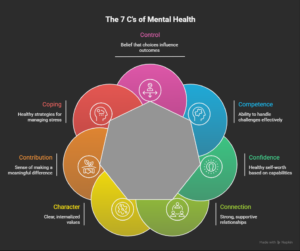
Increasingly used in both clinical and educational settings, the 7 C’s of mental health represent core competencies for psychological wellbeing:
- Competence — The ability to handle challenges effectively
- Confidence — A healthy sense of self-worth grounded in real-world capabilities
- Connection — Strong, supportive relationships with others
- Character — A clear, internalized set of values
- Contribution — The sense of making a meaningful difference
- Coping — Healthy strategies for managing stress and adversity
- Control — The belief that your choices matter and influence outcomes
These aren’t just motivational buzzwords. Each C maps to evidence-based outcomes in mental health research. Working on even one or two can shift your psychological baseline considerably.
What Are Unhealthy Mental Health Habits? (And Why They’re So Sticky)
Understanding what not to do is as important as knowing what to do. The most clinically significant unhealthy mental health habits include:
- Chronic sleep deprivation — Normalizing six or fewer hours as “enough”
- Emotional avoidance — Suppressing feelings rather than processing them
- Excessive social media consumption — Particularly passive scrolling, which is strongly linked to social comparison and low self-esteem
- Catastrophizing — A cognitive distortion where the mind defaults to worst-case scenarios
- Isolation — Withdrawing from relationships when stressed, which deepens the cycle
- Alcohol as a coping mechanism — Self-medicating emotional pain
- Neglecting physical health — Treating the body as separate from the mind
What makes these habits so persistent is that many of them provide immediate relief from discomfort numbing, distraction, avoidance. The brain is wired for short-term reward. Building mental health habits is, in part, an exercise in training your longer-term self to override your short-term impulses. That’s the work.
What Are the 5 Pillars of Good Mental Health?
| Pillar | Description |
|---|---|
| Emotional Wellbeing | The ability to experience and express a full range of emotions healthily |
| Psychological Wellbeing | A sense of purpose, agency, and personal growth |
| Social Wellbeing | Quality of relationships and sense of belonging |
| Physical Health | Sleep, nutrition, exercise — the body as foundation |
| Cognitive Wellbeing | Mental clarity, focus, and the ability to learn and adapt |
A life built on all five pillars isn’t just one where you avoid breakdown it’s one where you genuinely thrive.
How to Stop Overthinking: A Clinically Grounded Approach
Overthinking is the stealth enemy of mental wellbeing particularly among high-achieving professionals who mistake rumination for problem-solving. Doctors and therapists have a few consistently recommended strategies:
Schedule your worry. This sounds counterintuitive, but designating a specific 15-minute “worry window” each day contains anxious thinking rather than letting it bleed into everything else.
Challenge the thought. Ask: Is this thought factually true? What’s the evidence? What would I tell a friend who thought this? This is the foundation of cognitive restructuring.
Engage your body. Physical movement interrupts the mental loop. A 10-minute walk, box breathing, or cold water on your wrists can rapidly shift your nervous system state.
Write it down. Journaling externalizes the internal narrative, reducing its psychological weight. Many therapists recommend this as a first-line habit for anxiety management.
FAQs: Your Burning Mental Health Questions Answered
What is the #1 worst habit for anxiety? Avoidance specifically, avoiding situations, feelings, or thoughts that trigger anxiety. While it provides immediate relief, avoidance reinforces the anxiety loop over time and narrows your world.
What drink calms anxiety? Herbal teas particularly chamomile and valerian root have mild anxiolytic properties backed by some clinical evidence. More significantly, staying well-hydrated and reducing caffeine intake has a meaningful impact on baseline anxiety levels.
What is the golden rule of mental health? Consistency over intensity. Small habits practiced daily sleep, movement, connection, stillness compound into profound mental wellbeing over time. No single heroic intervention replaces the quiet discipline of showing up for yourself every day.
What are the 3 R’s of anxiety? Recognize the anxiety. Reframe the thought or situation. Respond rather than react. This three-step framework is used in therapeutic settings to build emotional agility.
What should a 70-year-old be doing for mental health? The same fundamentals apply, with emphasis on social engagement, cognitive stimulation (reading, learning new skills), regular gentle exercise, and maintaining a sense of purpose whether through volunteering, creative pursuits, or mentorship.
The Bottom Line: Small Habits, Seismic Shifts
Mental health isn’t a destination you arrive at it’s a practice you return to, daily, with patience and intention. The habits doctors recommend most aren’t complicated or inaccessible. They’re grounded in the oldest wisdom about human flourishing: sleep, move, connect, eat well, find stillness, and reach out when you need support.
What makes them powerful isn’t any single habit in isolation. It’s the compound effect of showing up for yourself consistently even imperfectly over weeks, months, and years.
If you’re ready to take the next step, explore the American Psychiatric Association’s lifestyle guidance for clinical grounding, dive into Headspace’s evidence-based habit guides for practical implementation, or visit OneclickMed’s daily health resource for actionable day-by-day routines. And if you’re exploring therapeutic options, FamilyDoctor.org’s treatment guide is an excellent starting point.
Your mental health is not a side project. It is the project. Start building today.
Did this article resonate with you? Share it with someone who could use a mental health reset and drop your own go-to mental health habit in the comments below.
Sources & References
- American Psychiatric Association — Lifestyle and Mental Health
- NIH — Exercise and Depression (BDNF Research)
- NHS — Mindfulness-Based Cognitive Therapy (MBCT)
- NIH — Gut-Brain Axis and Nutritional Psychiatry
- CDC — Loneliness and Social Isolation Health Effects
- NIH — Sleep and the Glymphatic System
- FamilyDoctor.org — Mental Health Treatment Overview